





- BRNN
- BRI News
- BRNN News
- Database
Official Documents Polices and Regulations
Inter-government Documents International Cooperation BRI Countries
Business Guide Economic Data BRI Data
Trade
Investment Projects Latest projects
Cases - Content Pool
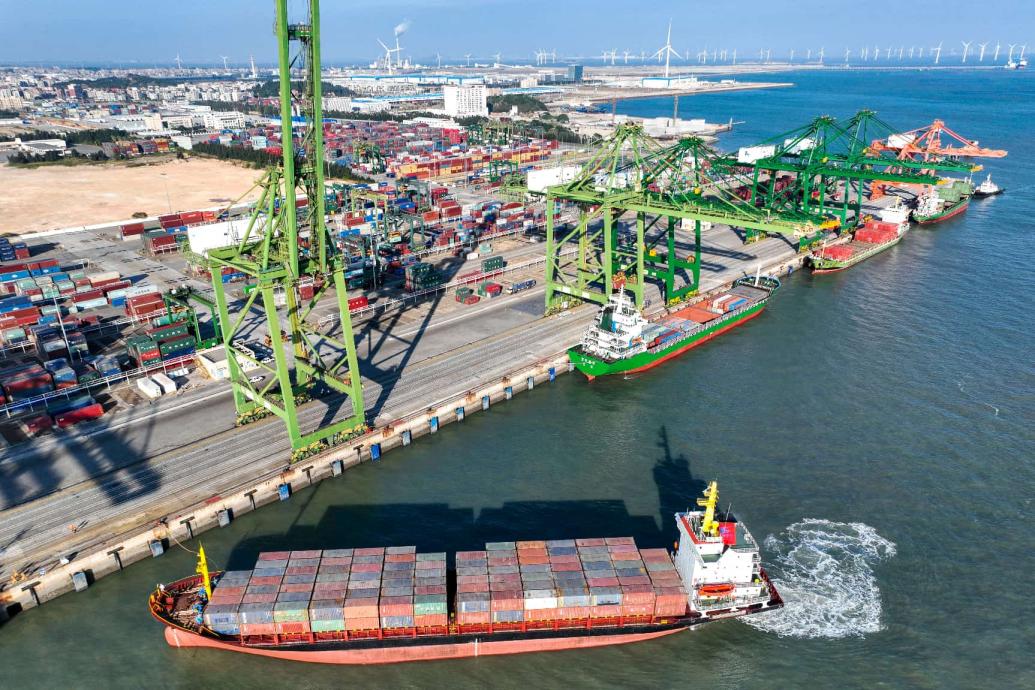
A cargo vessel docks at the Port of Jiangyin, Fuqing, southeast China's Fujian province. (Photo/Xie Guiming)
As global trade continues to evolve, China is accelerating efforts to integrate ports, shipping, and trade through more efficient and intelligent logistics networks. A key platform in this push is the Silk Road Maritime, the country's first comprehensive international logistics service platform centered on maritime shipping under the Belt and Road Initiative.
Launched in southeast China's Fujian province in 2018, Silk Road Maritime has expanded rapidly. Today, it operates 148 routes originating from more than 10 Chinese ports, connecting to 150 ports across 48 countries and regions. It has become an important link bridging domestic and international markets and connecting land and sea corridors.
The platform has demonstrably improved both efficiency and scale. For instance, a newly launched container route from Fujian to Latin America has shortened sailing time by more than seven days. By February 2026, cross-border e-commerce goods transported via dedicated express shipping lines had achieved an export value exceeding 15 billion yuan ($2.2 billion), while bulk and breakbulk cargo routes had handled goods worth over 32 billion yuan.
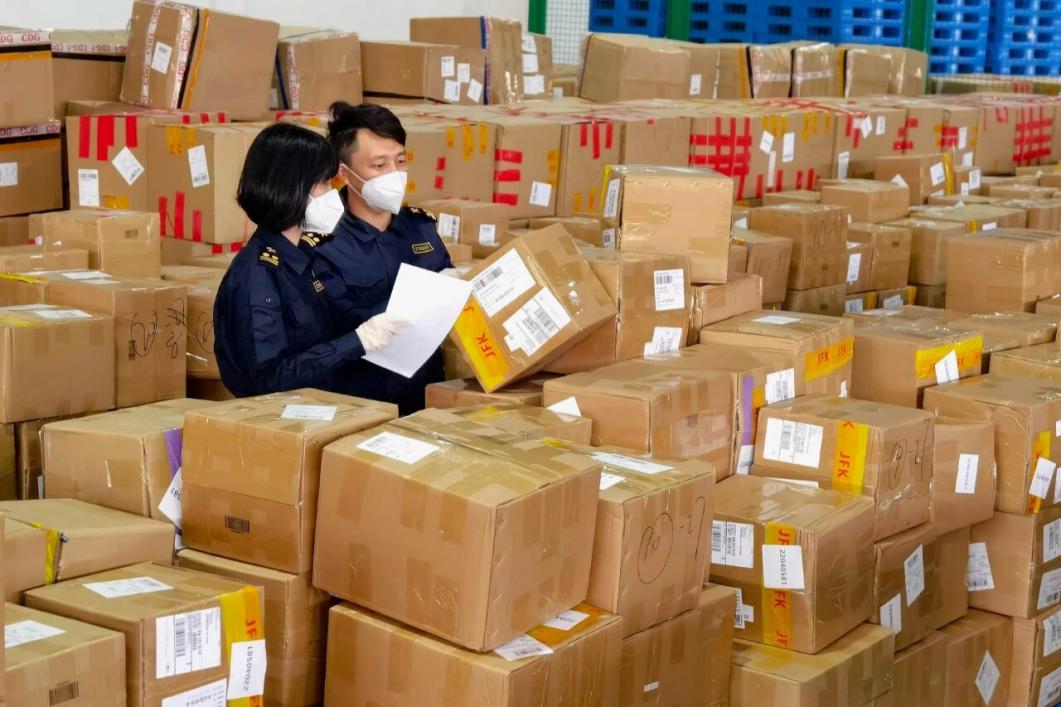
Xiamen Customs officials inspect e-commerce commodities to be exported. (Photo from China Customs Media Center)
At Xiamen Port's Haitian Terminal, a cargo vessel carrying more than 6,000 parcels of cross-border e-commerce goods, including apparel, small appliances, and daily necessities, recently set sail. Just two days later, the shipment would arrive at Manila Port in the Philippines.
Such efficiency was once unimaginable for Sun Kaiyang, general manager of a supply chain company based in Xiamen, Fujian province, the shipper of the above cargo. "In the past, we had to wait until enough goods were consolidated into a full container, then truck them to another port ahead of schedule. Delivery times were hard to guarantee."
Cross-border e-commerce shipments are typically small in volume, frequent, and highly time-sensitive, posing challenges for traditional shipping logistics.
To address this, the first Silk Road Maritime e-commerce express route was launched in June 2022. Since then, a growing network of such routes has enabled direct, point-to-point shipping from Xiamen to major ports in countries including Singapore, the Philippines, Malaysia, Vietnam, and Thailand.
"Now we can deliver, load, inspect, and dispatch all on the same day," Sun said. "The logistics chain has been significantly shortened."
Xiamen has also introduced an innovative mixed-container model, allowing e-commerce parcels and general trade goods to be shipped together. This has expanded cargo sourcing and increased flexibility in customs clearance.
"Overall, transport time is reduced by about two days, and each container saves around 4,000 yuan in shipping costs, significantly boosting competitiveness," Sun added.
Customs authorities have also streamlined procedures. "We've simplified declaration requirements and optimized inspection processes," said Cai Shaojun, deputy head of the logistics supervision division at Dongdu Customs under Xiamen Customs.
Compared with traditional models where different types of goods require separate warehousing and export, this integrated approach improves logistics time efficiency by 25 to 50 percent and is expected to cut costs per shipment by 10 to 25 percent, according to the official.
For long-distance maritime transport, reliable weather forecasting is critical.
In early November last year, Captain Zhang Nan of Meico International Shipping Limited faced a difficult decision while navigating a route from Penang, Malaysia, to Nansha Port in China's Guangdong province, as Typhoon Kalmaegi approached.
"Before departure, we hesitated -- whether to wait it out or detour, both options meant delays and higher fuel costs," he recalled.
Using Silk Road Maritime's meteorological navigation service, the crew gained access to real-time visual forecasts covering the next five days, including the typhoon's trajectory, wind conditions, and wave patterns. Supported by a team of meteorological and maritime experts, they determined that the vessel could proceed safely. The ship continued on its planned course, avoiding a 12-hour delay and saving 10 tons of fuel.
Behind this capability is an integrated meteorological service platform jointly developed by Silk Road Maritime, a Beijing-based global navigation company, and the Xiamen meteorological service center. The platform combines data on wind, waves, pressure, and visibility, forming a full-chain, all-weather support system spanning ocean routes, ports, and inland logistics.
Digitalization is another key pillar of Silk Road Maritime's development. Its international shipping service platform uses big data and the Internet of Things to integrate resources across the logistics chain, monitoring container movements in real time, optimizing route planning, and delivering more efficient and reliable services.
The platform is also expanding its ecosystem. At the 2026 Silk Road Maritime Annual Meeting held in Nanning, south China's Guangxi Zhuang autonomous region, on March 26, eight new members joined the Silk Road Maritime Association, bringing total membership to 375.
"With coordinated support from the alliance, ports can prioritize berthing and streamline vessel handling, significantly improving turnaround efficiency," said Fan Xiehui, a manager at the Xiamen branch of SITC Container Lines (Shanghai) Co., Ltd., adding that as a member of the association, the company has seen tangible benefits.
Li said the Silk Road Maritime will continue to pool global resources and explore coordinated development models linking ports, cities, industries, and trade, with the aim of building a smarter, more integrated ecosystem for international shipping and trade.

Tel:86-10-65363107, 86-10-65368220, 86-10-65363106
 Scan the QR Code
 Follow Us