





- BRNN
- BRI News
- BRNN News
- Database
Official Documents Polices and Regulations
Inter-government Documents International Cooperation BRI Countries
Business Guide Economic Data BRI Data
Trade
Investment Projects Latest projects
Cases - Content Pool
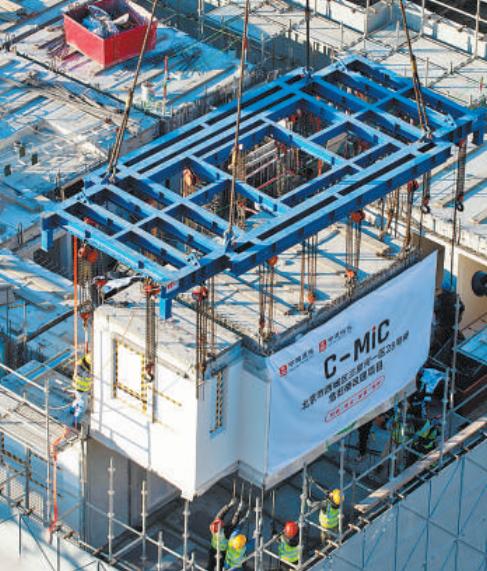
Photo shows the old residential area renovation project in Yuetan neighborhood, Xicheng district of Beijing. (Photo provided by China State Construction International Holdings Limited)
Across China, new construction methods are reshaping how residential and industrial buildings are built. By embracing prefabricated, modular techniques, localities are exploring ways to integrate faster, greener, and higher-quality construction into both public housing and industrial development.
Unlike traditional building methods, modular construction shifts much of the work to factories, where components are prefabricated and then assembled on-site. This approach reduces construction time while improving quality control and environmental performance.
For 74-year-old Ms. Liu Guilan, the return has been a pleasant surprise. Her new apartment is larger, better designed, and free from the persistent plumbing issues that plagued her old building.
"It took less than six months from vacating the old house to receiving the keys to the new one," she said with a smile. "I've been living here for 40 years, and I never imagined I could move into a brand-new home exactly on the same site."
This building was originally constructed in 1978. Due to its long service life and lack of maintenance, it suffered from structural aging and exterior wall cracks, and was included in Beijing's urban renewal program in 2023.
Demolition of the old building kicked off in July last year, and the construction of the new building started in September of the same year. After that, all modular hoisting was completed in only 46 days, with the main structure capped.
The speed and quality gains were made possible by modular integrated construction (MiC) technology.
"Using digital twin technology, we broke the entire building down into 156 standardized modules," said Pei Jiangfei from the contractor, China State Construction Hailong Technology Company Limited.
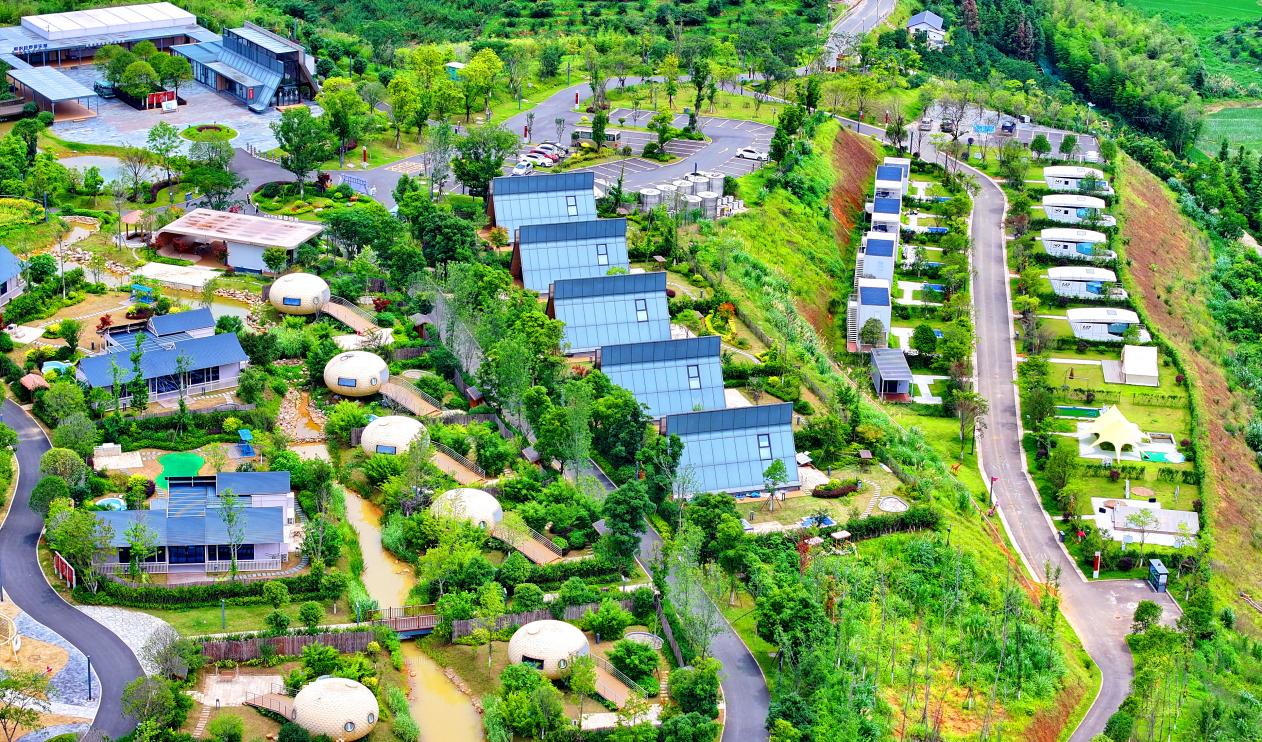
Photo shows prefabricated residential houses in Shihedi village, Ganzhou, east China's Jiangxi province. (Photo/Zhu Haipeng)
According to Pei, more than 90 percent of the work, including structural casting, insulation, pipeline installation, and interior finishing, was completed at a smart factory in Langfang, Hebei province, which borders on Beijing. After undergoing millimeter-level precision checks and rigorous performance testing, the modules were transported to the site and assembled with high accuracy.
This method reduced construction time by about 75 percent while delivering environmental benefits: construction waste dropped by 75 percent, material loss by 25 percent, and carbon emissions by 30 percent. Dust and noise pollution were also significantly lower.
When these modules were fabricated, each of them was assigned a unique digital identity, with all production data recorded throughout the entire process. Upon delivery, this information was converted into a digital archive for each apartment, clearly marking the precise locations of internal wall pipelines and equipment. This provides digital support for later operation and maintenance, ensuring residents can live more securely and at ease.
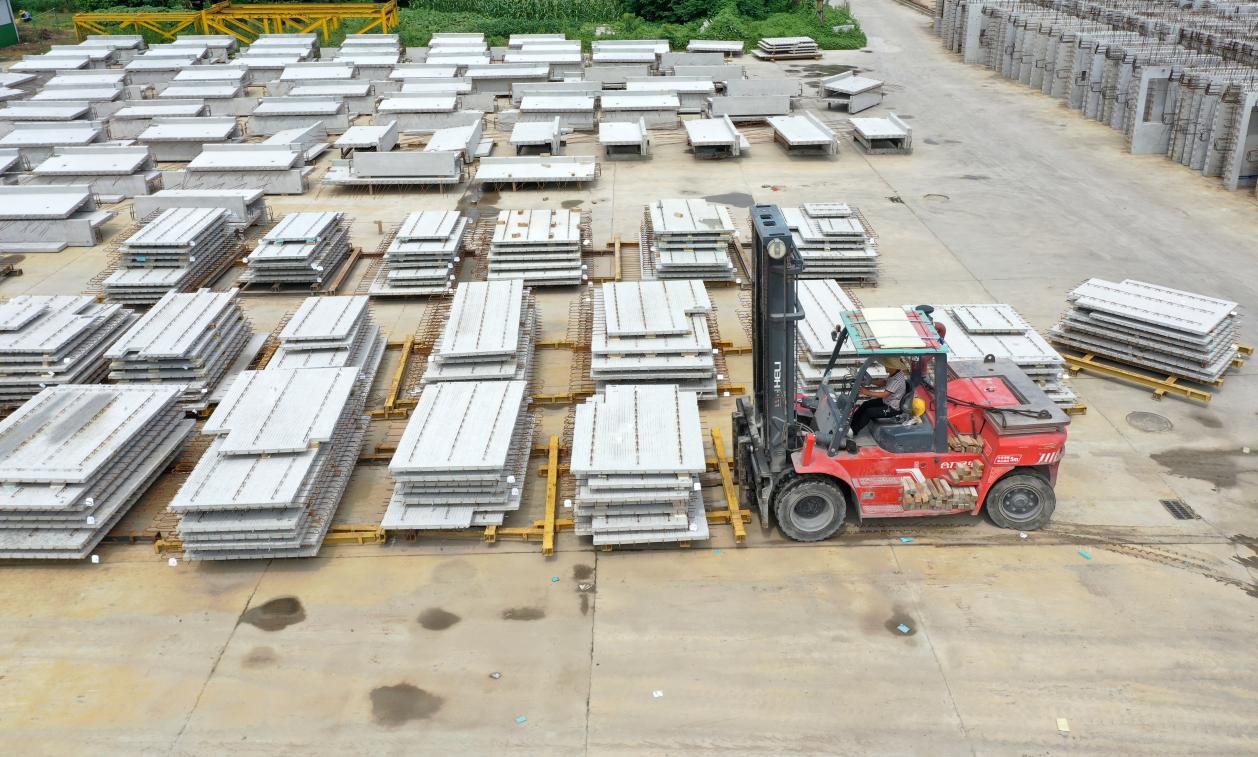
Photo shows prefabricated building components in a yard of a factory in Bozhou, east China's Anhui province. (Photo/Hu Weiguo)
Modular construction is expanding beyond cities into rural areas.
In Yuhuang community in Fucheng district, Mianyang, southwest China's Sichuan province, rows of newly built houses with white walls and gray tiles are scattered in an orderly manner. Unlike traditional rural houses, these two-story detached homes adopt a prefabricated light steel structure.
Seventy-year-old villager Wang Weiying has lived in her new home for five years. The house, with a floor area of about 180 square meters, cost roughly 300,000 yuan ($43,978) to build. "The price is about the same as a traditional brick-and-concrete house, but it has many advantages," Wang said.
"In the past, we had to lay bricks one by one. Now it's like building with blocks -- the main structure was completed in about 40 days, cutting the construction time in half," Wang recalled.
"And it's much more comfortable to live in. Even during the rainy season, the house stays dry and mold-free. Compared with old brick houses, it's warmer in winter and cooler in summer," she added.
"It's also well insulated from noise. You can't hear conversations or even chickens outside," one of her neighbors chimed in.
Industrial projects similarly benefit. At an industrial park in Suqian, east China's Jiangsu province, a modern factory building recently took shape through modular assembly. Steel columns were hoisted into place with precision, forming the structure of a 20,000-square-meter facility for a tech firm.
"Previously, constructing a factory of this size would take more than eight months and could be easily delayed by weather," said project manager Wang Jian. "With modular construction, the entire process from groundbreaking to completion took just about four months."
On-site work that once relied heavily on formwork, rebar, and concrete has been largely replaced by standardized component production in factories. This not only speeds up construction but also reduces the cost of dust and noise control.
Other advantages are equally compelling: more consistent quality, longer building lifespan, flexible layouts that can be adjusted to production needs, and shorter timelines that allow companies to begin operations sooner. These factors are driving more industrial projects to adopt modular methods. In Suqian, the floor area of newly started prefabricated buildings grew from 834,300 square meters in 2020 to over 1.5 million square meters in 2024.
Prefabricated construction is a key pathway toward industrialized, intelligent, and green building. With supportive policies, advancing technologies, and growing market demand all converging, the sector is poised for rapid growth, helping to build a more robust industrial ecosystem and accelerate the transformation and upgrading of the construction industry.

Tel:86-10-65363107, 86-10-65368220, 86-10-65363106
 Scan the QR Code
 Follow Us