





- BRNN
- BRI News
- BRNN News
- Database
Official Documents Polices and Regulations
Inter-government Documents International Cooperation BRI Countries
Business Guide Economic Data BRI Data
Trade
Investment Projects Latest projects
Cases - Content Pool
As the spring farming season enters a critical stage, major grain growers in Huaxian county, central China's Henan Province no longer need to walk the fields to check conditions. With a simple tap on their phones, satellite remote-sensing maps now clearly show field boundaries, soil moisture levels and crop growth status.
Farming has shifted from relying on experience alone to being guided by data, thanks to China's world-leading agrometeorological observation network.
The country has established a modern agrometeorological observation system, comprising 642 manual observation stations, 738 automatic observation stations, 15 specialized service centers and 91 experimental stations.
Together, they form an integrated monitoring network for food security, combining satellite remote sensing from space, drone and radar observation from the air, and dense ground-based monitoring.
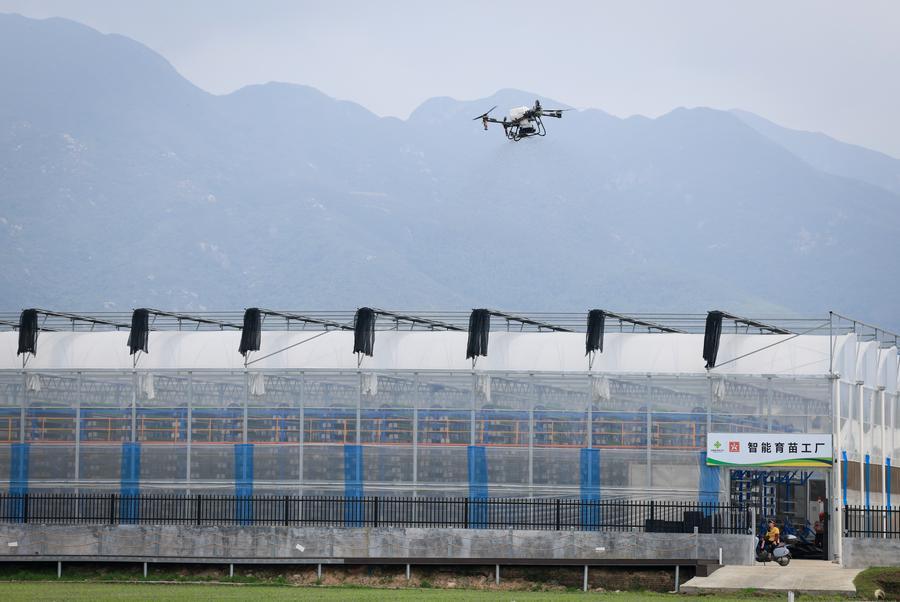
An agricultural drone works above the fields in Duhu Town of Taishan, south China's Guangdong Province, March 24, 2026. (Xinhua/Mao Siqian)
High-resolution meteorological data is now embedded throughout agricultural production. It helps farmers plan farming schedules, warn of disaster risks and provide tailored farming advice.
An official from the China Meteorological Administration (CMA) noted that data sharing across departments is being strengthened, with priority given to major grain-producing areas, greenhouse and controlled-environment farming zones, and key specialty farming regions.
Hundreds of kilometers above the vast winter wheat producing regions in north China and the Huanghuai region, Fengyun meteorological satellites operate around the clock, continuously transmitting real-time agricultural monitoring data to support spring farming.
According to Zhang Mingwei, a researcher at the National Satellite Meteorological Center, the Fengyun meteorological satellite network uses three coordinated satellites to capture observations throughout the day, covering morning, midday and afternoon. Together, they deliver field environmental data every six hours, tracking temperature fluctuations and helping farmers determine the optimal timing for sowing.
In Henan, 48 phenology observation systems are now closely integrated with Fengyun meteorological satellites and drone data.
"By integrating data from multiple sources, we are able to deliver wheat growth monitoring products that make every stage of development and every change in soil moisture across the province clearly visible, easy to interpret and accurately tracked," said Tian Hongwei, a senior engineer at the Henan Provincial Meteorological Bureau.
In central China's Hunan Province, high-standard farmland meteorological stations keep close watch over growing conditions. By continuously tracking temperature and humidity in seedling greenhouses, they can automatically alert farmers to risks such as heat stress. Over the past nearly three years, the system has helped cut early-season rice seedling losses by 20 percent and reduce nursery costs by more than 10 percent.
Wu Dongli, deputy head of the system division of the CMA Meteorological Observation Center, said that China has built a world-leading agrometeorological observation system supported by artificial intelligence, laser technology, remote sensing and other technologies.

Tel:86-10-65363107, 86-10-65368220, 86-10-65363106
 Scan the QR Code
 Follow Us