





- BRNN
- BRI News
- BRNN News
- Database
Official Documents Polices and Regulations
Inter-government Documents International Cooperation BRI Countries
Business Guide Economic Data BRI Data
Trade
Investment Projects Latest projects
Cases - Content Pool

A social worker teaches an elderly resident how to use AI to check the weather at the Party-citizen service center of Pingshan neighborhood, Pingshan subdistrict, Pingshan district, Shenzhen, south China's Guangdong Province, March 21, 2026. (Photo/Zeng Xiaoyan)
As artificial intelligence increasingly integrates into health care, shopping, entertainment and other aspects of daily life, more elderly Chinese are showing a keen interest in learning to use AI tools — viewing them as a gateway to a richer, more connected retirement.
Yet for many seniors, that curiosity comes with anxiety. Fear of making costly mistakes, falling victim to online scams or simply being laughed at for struggling to keep up has discouraged many from taking the first step.
Cities like Shanghai in east China and Shenzhen in south China's Guangdong Province have begun to address this challenge, developing tailored courses that prioritize hands-on practice and place fraud prevention front and center.
At Shanghai Jing'an District College, AI courses start with apps seniors already know — WeChat and Douyin — before gradually introducing more specialized tools such as Doubao, DeepSeek and Jimeng, a Midjourney-like AI image-generation tool.
To accommodate slower reaction times and impaired vision, the college pairs a dedicated instructor with volunteer teaching assistants who work one-on-one with trainees.
Since the start of 2025, the college has also integrated anti-fraud content throughout its AI courses, guiding participants step by step on how to block spam calls, enable delayed fund transfers and cancel unwanted auto-subscriptions.
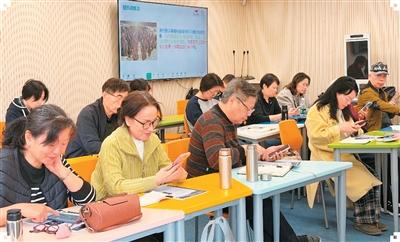
Photo shows an AI class at Shanghai Jing'an District College in Shanghai, April 1, 2026. (Photo courtesy of Shanghai Jing'an District College)
The China Aging Development Foundation and Tencent jointly launched a community AI program at a Party-citizen service center in Longtian subdistrict, Pingshan district, Shenzhen, in March.
The program avoids technical jargon and focuses on practical skills seniors can readily apply. Volunteers break down complex concepts into everyday scenarios: How do you check vegetable prices on your phone? What should you do if you feel unwell and want to consult AI? What do you do when you receive a suspicious text with a link?
Through a combination of one-on-one coaching and role-playing exercises, participants have gradually shifted from asking for help to trying things themselves.
"We're not afraid of seniors learning slowly — we're afraid of them being too scared to try," said Jiang Zhonghua, president of Shanghai Jing'an District College.
Lan Qi, a social work supervisor at the Party-citizen service center, is equally upbeat, saying that with the right approach, elderly learners not only pick up AI skills but also enjoy the process. "We've run six consecutive courses for seniors, and all 200-plus spots were snapped up instantly," Lan said.
Experience has shown that AI tools only truly take root among the elderly when they are woven into daily life, helping seniors handle medical needs, travel, cook meals or look after grandchildren. This is what moves older adults from being willing to try AI to using it effectively.

Members of a storytelling group launched by Meng Yongmei, a member of a volunteer squad called the "silver-haired digital experience officers," use AI to create skits in Jing'an district, Shanghai. (Photo/Lin Fei)
"Look at this Vietnamese translation I did with Doubao — I have no more language worries when traveling abroad," said Fang Hong, a 60-year-old trainee in Shanghai, beaming as she showed off her phone. Before learning about AI, she had used her smartphone for little more than chatting on WeChat.
"Things are different now. I can leave home without my wallet, but not without my phone. I use it for the subway, taxis, meals, shopping and navigation — everything," she said.
On a family trip to Vietnam this year, she used Doubao to overcome language barriers and convert currencies while shopping. "I used to be afraid to travel far from home. Now I can buy tickets and find my way around on my own, and I don't worry about being scammed."
What kinds of AI applications are most popular with senior users? Chen Yuqing, a volunteer who has run dozens of AI public welfare courses in Pingshan district, Shenzhen, has a clear answer: "Apps that are simple to use and genuinely useful, with voice interaction support and a clean interface."
A cross-border e-commerce professional by trade, Chen spends his spare time developing and teaching public welfare AI courses, bringing them to multiple nursing homes.
In his experience, seniors gravitate toward applications that meet everyday needs — scam detection, health consultations, recipe searches and medical report interpretation — while also embracing tools that enrich their emotional lives, such as restoring old photographs and generating creative content.
In Jing'an district, a volunteer group known as the "silver-haired digital experience officers" has become a familiar presence in the push for digital inclusion among the elderly. Built around Shanghai Open University's "elder e-school" online platform, the team recruits adults aged between 50 and 70, provides training, and enables them to teach digital skills to other seniors in their communities, report local needs and serve as volunteer teaching assistants.
Meng Yongmei, nearly 60, is a case in point. After retiring a few years ago, she enrolled at Shanghai Jing'an District College to study vocal music, where she discovered the college's AI courses and was immediately hooked. She not only took up the classes herself and applied the skills in daily life, but also volunteered as a teaching assistant with the volunteer group.
Last year, she launched a storytelling group, which has since attracted more than 30 members aged 60 and above, teaching them how to use AI to tell stories and document their lives.
In October 2024, Shenzhen built an "AI night school" system under a city-district coordination model. The city now has AI night school courses running across 625 communities, with more than 5,000 courses and over 8,000 sessions held to date, serving more than 400,000 visits by elderly learners.
An "8-minute smart learning circle" delivers AI courses to communities across Shanghai's Jing'an district. In 2025, the program covered 14 sub-districts and towns and 248 urban residents' committees, with 334 sessions attracting more than 6,200 elderly participants.
Anti-fraud education remains a constant across all six themed modules, including safety, health, transportation, home life, daily living, and culture and entertainment.

Tel:86-10-65363107, 86-10-65368220, 86-10-65363106
 Scan the QR Code
 Follow Us