





- BRNN
- BRI News
- BRNN News
- Database
Official Documents Polices and Regulations
Inter-government Documents International Cooperation BRI Countries
Business Guide Economic Data BRI Data
Trade
Investment Projects Latest projects
Cases - Content Pool
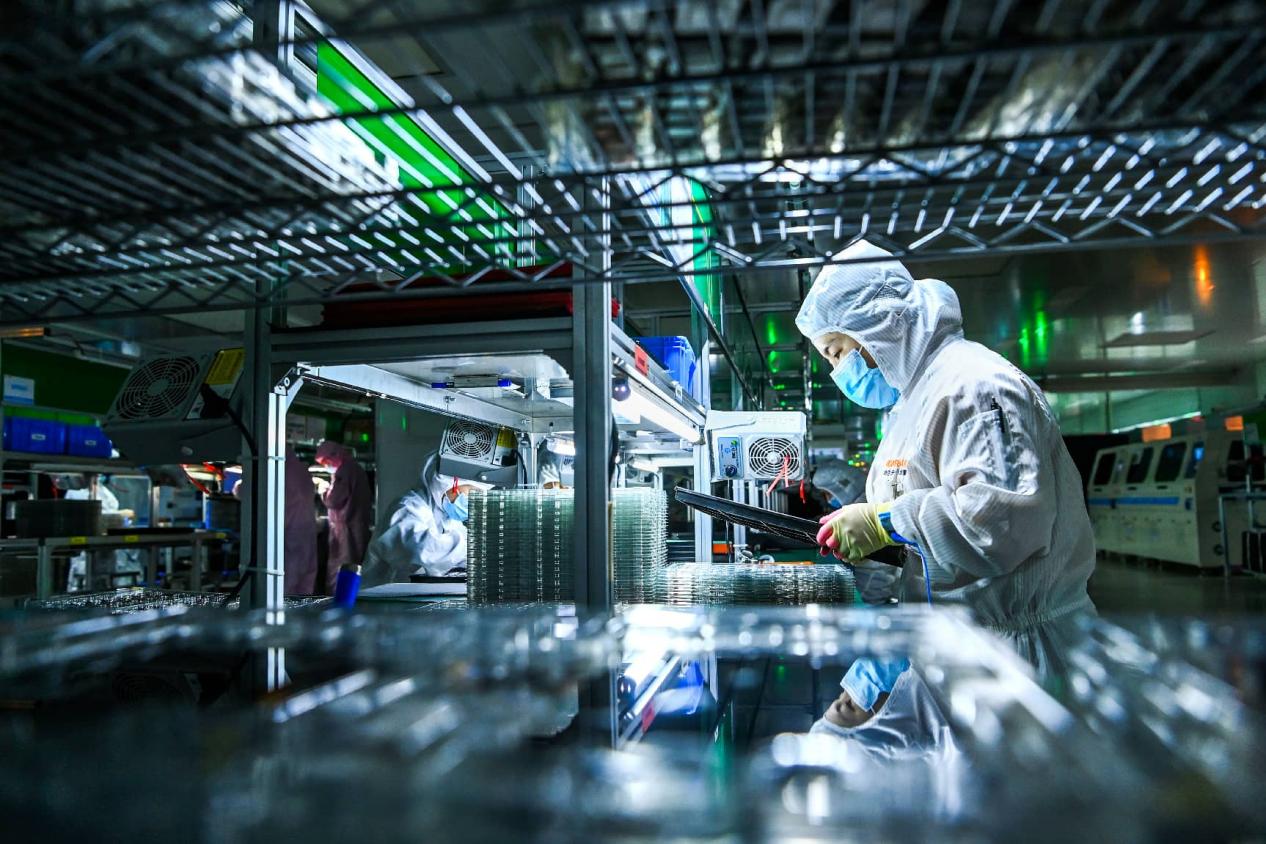
Display products for domestic and international market are manufactured in a workshop of a tech firm in Yichun, east China's Jiangxi province. (Photo/Zhou Liang)
China recently unveiled its economic performance for the first quarter of 2026. Its GDP reached 33.4193 trillion yuan ($4.9 trillion), up 5 percent year on year in real terms, accelerating by 0.5 percentage points from the fourth quarter of last year.
The figures have drawn close attention from the international community, which generally believes that amid rising global uncertainty, China's economy has demonstrated resilience and vitality, injecting much-needed stability and positive momentum into the world.
At present, global instability is intensifying. The spillover effects of geopolitical conflicts are expanding, and international organizations such as the UN and the Asian Development Bank have warned of growing downside risks. The global economy is moving forward under pressure.
In the face of mounting external uncertainties, China's economy continues to display strong resilience, robust internal momentum, and proactive, effective macroeconomic policies. Phrases such as "better than expected" and "growth against the headwinds" have frequently appeared in international media coverage.
Kristalina Georgieva, Managing Director of the International Monetary Fund, noted that China's economy has shown resilience, possesses immense potential, and will have a positive impact on the world.
Driven by innovation, high-quality development surges forward. In the first quarter, China's equipment manufacturing sector contributed nearly 50 percent to the growth of value added in industrial enterprises above designated size. In the first two months of the year, high-tech manufacturing accounted for more than half of the increase in total industrial profits, underscoring the growing role of new growth drivers.
China's industries are advancing rapidly toward high-end, intelligent, green and upgraded development, delivering continuous breakthroughs in fostering new quality productive forces.
Exports of green products such as electric vehicles, lithium-ion batteries, and wind turbines and their components rose by 77.5 percent, 50.4 percent, and 45.2 percent, respectively. Meanwhile, investment in frontier fields including AI and humanoid robotics increased by 45.5 percent year on year, and the business vitality index of technology-driven enterprises rose by 8.1 percent.
Global media outlets have observed promising signs: China's thriving clean energy technologies are creating huge economic value, and robust demand for AI devices is driving steady growth of China's foreign trade. These positive trends vividly demonstrate China's progress in developing new quality productive forces.
Domestic demand has also shown overall improvement, creating favorable conditions for sustained economic expansion.

A foreign tourist poses for a selfie in a garden in Heze, east China's Shandong province. (Photo/Li Baozhu)
Promoting a development model driven more by domestic demand, consumption, and endogenous growth reflects China's strategic response to changes in its development stage and the evolving international environment.
In the first quarter, retail sales of consumer goods grew by 2.4 percent year on year, while fixed-asset investment returned to positive growth, indicating that the domestic market continues to deepen and expand.
At the sixth China International Consumer Products Expo held in Hainan province, a wide range of global debuts, Asia-Pacific premieres, and China launches were showcased, further strengthening China's reputation as a premier global destination for quality consumption.
The country's vast market continues to empower economic development. Some U.S. media outlets observed that China is transitioning toward a more diversified growth model, one that benefits not only China itself but also offers valuable lessons for the global economy.
Amid profound adjustments in the global economic landscape, China remains committed to high-level opening up, creating broad opportunities for the world through its own development.

Consumers shop for smartphones at a shopping mall in Xi'an, northwest China's Shaanxi province. (Photo/Zhang Cheng)
A series of opening-up measures have been rolled out, including the launch of island-wide independent customs operations at the Hainan Free Trade Port, revisions to the Foreign Trade Law to better align with international rules, and an expanded version of the Catalogue of Encouraged Industries for Foreign Investment. These steps are improving both the quality and scale of trade cooperation.
In the first quarter, China's total goods trade exceeded 11 trillion yuan for the first time in the same period, maintaining double-digit growth and reaching the highest quarterly growth rate in five years.
Its trade with Belt and Road partner countries accounted for 51.2 percent of the total, while trade with Africa grew by 23.7 percent. Trade with ASEAN, Latin America, the European Union, the United Kingdom, and other APEC economies also recorded double-digit growth. China's role as a "world market" continues to generate positive spillover effects globally. A more open China will remain a steady anchor for the world economy as it navigates challenges.
The year 2026 marks the opening of China's 15th Five-Year Plan period (2026-2030). Stable economic growth provides a solid foundation for a strong start to this new phase, while also serving as a stabilizer for the global economy amid turbulent conditions. China will continue to inject sustained confidence and strong momentum into global development.

Tel:86-10-65363107, 86-10-65368220, 86-10-65363106
 Scan the QR Code
 Follow Us