





- BRNN
- BRI News
- BRNN News
- Database
Official Documents Polices and Regulations
Inter-government Documents International Cooperation BRI Countries
Business Guide Economic Data BRI Data
Trade
Investment Projects Latest projects
Cases - Content Pool
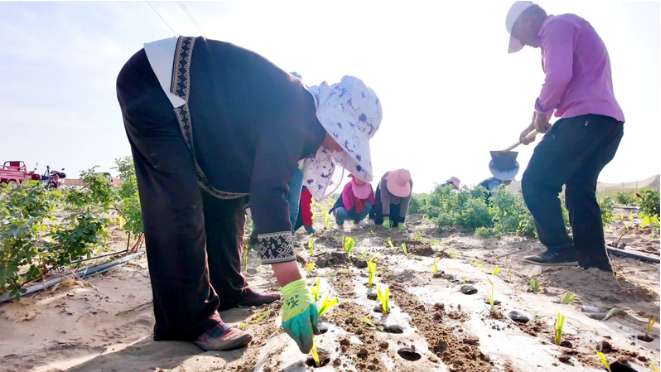
Residents interplant blackberry lily, a perennial herb, at Wanhuayuan Desertification Control Zone in Yutian county, Hetian prefecture, northwest China's Xinjiang Uygur Autonomous Region. (Photo/Gao Meihuizi)
At the edge of the Taklamakan Desert, once known as the "Sea of Death," in northwest China's Xinjiang Uygur Autonomous Region, a win-win situation for desertification control and livelihood improvement has taken shape, bringing vast stretches of greenery to the desert and big smiles to locals' faces.
In 2025, the Taklamakan Desert sand-blocking green belt project was listed among the "2025 Top 10 Global Engineering Achievements" by the World Federation of Engineering Organizations. The project spans 3,046 kilometers and encircles the desert like a "green scarf" to control sand diffusion.
Central to this success is Xinjiang's integration of ecological restoration with rural revitalization under the vision that "lucid waters and lush mountains are invaluable assets."
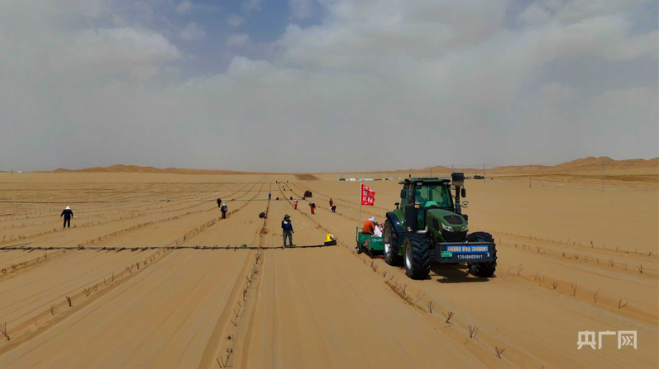
Machinery and workers work together at the Tiandong integrated desertification control demonstration area in Yutian county, Hetian prefecture, northwest China's Xinjiang Uygur Autonomous Region. (Photo/Gao Meihuizi)
As a key zone of the green belt, Hetian prefecture has been at the forefront of Xinjiang's desertification control efforts, serving as a vivid example of the region's desert management practices in action.
Building on local realities, Hetian has explored an innovative approach combining ecological restoration with economic gains, stabilizing the desert while generating tangible benefits for local communities.
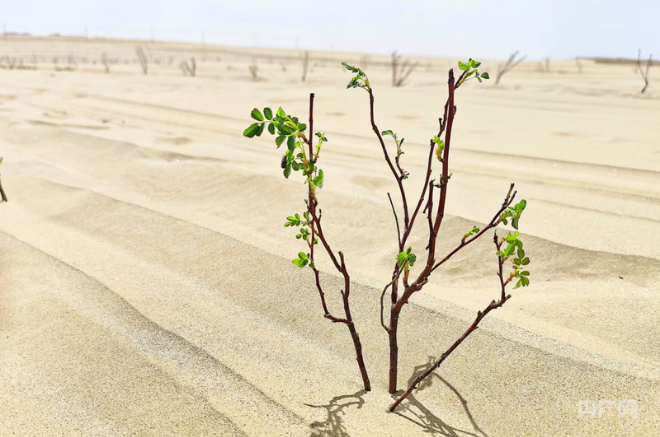
Photo shows newly sprouted desert roses at the Tiandong integrated desertification control demonstration area in Yutian county, Hetian prefecture, northwest China's Xinjiang Uygur Autonomous Region. (Photo/Ma Xiaoshan)
Yutian county in Hetian prefecture has been gradually refining a multi-layered desertification control model combining grass grids for sand fixation, rose hedges and intercropping with medicinal plants, which has become a replicable and scalable example for desert management.
The green belt was completed Nov. 28, 2024, with a final planting ceremony at Wanhuayuan Desertification Control Zone in Yutian county, where local officials and residents planted rose seedlings.
Today, the rose branches in the demonstration area have grown to 30-40 centimeters, their buds plump and ready to bloom, and a subtle fragrance drifts across the desert.
The drought-tolerant rose shrub is valued both for stabilizing soil and for its economic potential.
It has a deep root system and is highly drought- and poor-soil tolerant, making it a reliable ally for stabilizing sand and improving soil quality, while its petals and calyxes have notable economic value, laying the foundation for industrial development.
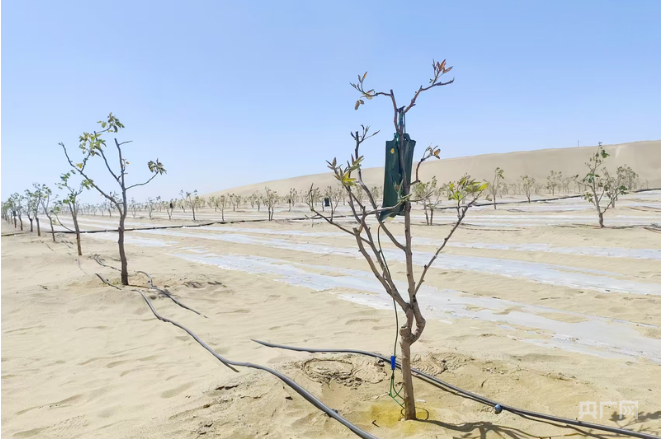
Ten-year-old pistachio saplings receive nutrient solution treatment in Lop county, Hetian prefecture, northwest China's Xinjiang Uygur Autonomous Region. (Photo/Ma Xiaoshan)
In recent years, Yutian county has built a complete industrial chain around the desert rose, developing more than 70 products and achieving a leap from planting roses to creating a full-fledged industry.
"This year, we will start seeing returns. Fresh flowers are expected to yield about 100 kilograms per mu (0.067 hectares), while dried petals could reach 100-150 kilograms per mu, bringing a net income of around 1,000 yuan ($146) to 2,000 yuan per mu," said Elijan Ubul, an official of Aoyituogelake township in Yutian county.
Local farmers are further boosting income through intercropping.
Medicinal plants such as mugwort and Chinese skullcap thrive alongside the roses and can be harvested multiple times a year.
Mugwort is drought- and cold-tolerant and easy to manage, according to Elijan Ubul, who explained that once planted, it can be harvested continuously for eight to 10 years, yielding two to three crops per year, with an annual output value of 1,500 yuan to 2,000 yuan per mu.
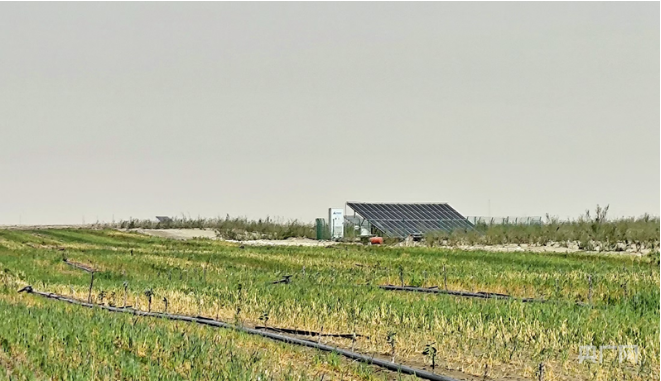
Photo shows sand plots at a public desertification control demonstration area along a highway in Hetian county, Hetian prefecture, northwest China's Xinjiang Uygur Autonomous Region. (Photo/Ma Xiaoshan)
Currently, 1,120 mu of mugwort are planned to be intercropped in the 3,100-mu core desert rose demonstration area, with 432 mu already planted, Elijan Ubul said.
The desertification control model of the Wanhuayuan Desertification Control Zone is now expanding to surrounding areas, prompting enterprises to increase planting and optimize production efficiency.
"When I first visited Wanhuayuan Desertification Control Zone in March last year, it was nothing but endless yellow sand without a hint of green," said kurban Mettursun, a manager of a local medicinal herb farm. "After a year of careful management, the soil conditions have improved, and the herbs we planted are thriving."
"With our continued efforts, we believe that this desert will gradually turn into an oasis, and the local people's lives will become increasingly prosperous," said kurban Mettursun, who is teaching planting techniques to six apprentices.
Across Hetian prefecture, many other counties are pursuing similar efforts to tackle desertification while boosting local livelihoods.
In Lop county's modern agricultural park, a 5,400-mu pistachio plantation combines ecological restoration with industrial development.
The project, supported by private investment, includes adaptive cultivation trials, precision irrigation and intercropping with maize and pumpkin to protect soil and ensure early returns.
It also provides job opportunities so that local workers earn a steady income while contributing to ecological stewardship.
In recent years, Lop county has completed a total of 270,000 mu of desertification control projects, according to Wang Zhiqiu, an official of Lop county's forestry and grassland bureau.
The county has innovatively allocated sand-affected land with precision. Local residents are given priority in managing plots that are near oases and in better condition, allowing them to directly benefit from desert control efforts.
Areas that are more difficult to develop and require higher investment are opened to enterprise investment, leveraging companies' financial and technical advantages.
This approach has created a joint effort between residents and enterprises, helping desertification control initiatives take root and achieve substantial results.
Hetian county, with a dense population, limited arable land and extensive sand-affected areas, followed Xinjiang's desertification control approach centered on local residents and aimed at stimulating endogenous driving force.
Local authorities have innovatively allocated land to villages and households and assigned land-use rights to individuals.
Desert control benefits are clearly designated to contracted farmers, with 30 mu to 50 mu of sand-affected land allocated per household, allowing more residents to participate in desertification control and share in the economic gains.
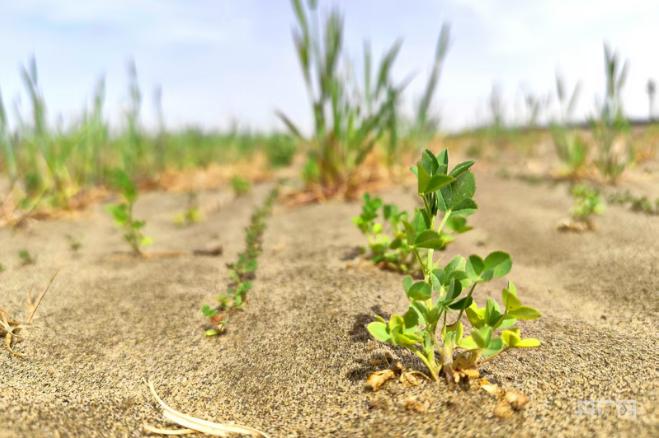
Photo shows newly sprouted alfalfa seedlings in a desertification control area in Hetian county, Hetian prefecture, northwest China's Xinjiang Uygur Autonomous Region. (Photo/Ma Xiaoshan)
In an effort to ensure residents can engage in desertification control without concerns, local authorities have increased investment and strengthened infrastructure support.
According to Ablikim Sawur, head of Hetian county's forestry and grassland bureau, the county has allocated 75.52 million yuan in rural revitalization funds. The investment has supported construction of 64 kilometers of gravel roads, 240 sets of distributed photovoltaic and energy storage facilities, and protective fences to address difficulties in transportation and irrigation for desert control.
In addition, the adoption of drought- and salt-tolerant native tree species and a photovoltaic-driven precision drip irrigation system has elevated the average seedling survival rate to over 85 percent, the official said.
The county has also intercropped alfalfa and Cistanche deserticola, a medicinal herb, between tree rows to expand farmers' income sources.
So far, Hetian county has engaged 1,868 households in desertification control and covered a total of 91,300 mu of sand-affected land.
As Hetian prefecture's locally adapted, science-based desertification control efforts have gradually strengthened the green belt around the Taklamakan Desert, a pathway to ecological and economic prosperity for local residents has taken shape, benefiting a growing number of people.
So far, Xinjiang has planted over 10.83 million mu of desert-adapted cash crops, generating a total output value of around 28.98 billion yuan, according to data released by Xinjiang's forestry and grassland bureau. The effort has provided stable employment for over 300,000 people and increased annual per capita income by 3,000 yuan to 4,500 yuan.

Tel:86-10-65363107, 86-10-65368220, 86-10-65363106
 Scan the QR Code
 Follow Us