





- BRNN
- BRI News
- BRNN News
- Database
Official Documents Polices and Regulations
Inter-government Documents International Cooperation BRI Countries
Business Guide Economic Data BRI Data
Trade
Investment Projects Latest projects
Cases - Content Pool
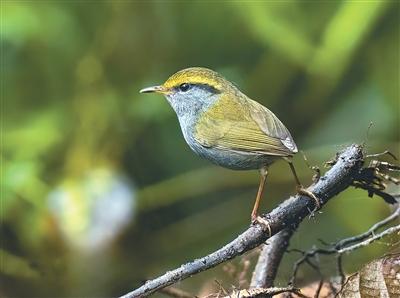
Photo shows a grey-bellied tesia, a "star" bird species in Napo county, south China's Guangxi Zhuang Autonomous Region. (Photo/Lin Xiuwen)
In the southwest part of south China's Guangxi Zhuang Autonomous Region lies Napo, a small county on the China-Vietnam border. At dawn on March 26, mist hung over the forests of the eastern section of the Laohutiao Nature Reserve. As a car wound its way up a mountain road, birdsong broke the silence.
"Stop the car. This is the call of a blue-throated barbet," said Wei Ming and Mo Guowei from the Kunming Rosefinch Bird Research Institute, scanning flowering kapok trees through binoculars. Amid the blaze of red blossoms, a green bird flashed into view.
That same day marked the start of Napo's first bird-watching competition. Fourteen teams and over 60 participants from across China fanned out along nine routes, racing to spot and record as many species as possible.

Lin Xiuwen (middle) and two birdwatching enthusiasts watch birds in Napo county, south China's Guangxi Zhuang Autonomous Region. (Photo courtesy of Lin Xiuwen)
"Napo has long been known for its ethnic culture and star anise. But would people really travel all this way just to watch birds?" said Yang Jianfeng, a county official. It didn't take long to get the answer—absolutely.
By the competition's close, participants had recorded 259 valid species.
According to Mo, Napo recorded just eight bird-watching entries in 2018; by 2025, that number had surged to 9,032.
Countywide bird records now stand at 371 species, including 10 newly documented ones. Among them is the endangered Mrs. Hume's pheasant, a species under first-class state protection in China.
Behind these numbers lies decades of ecological conservation, said Yang.
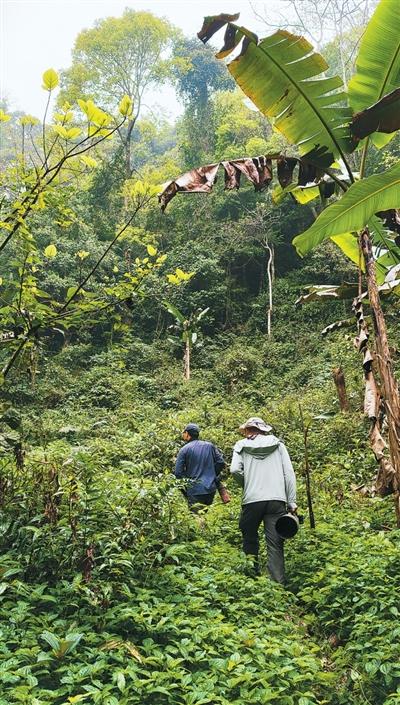
Contestants search for birds during the first birdwatching competition in Napo county, south China's Guangxi Zhuang Autonomous Region. (Photo/Guo Dandan)
In recent years, Napo has strengthened forest protection, cracked down on illegal hunting, and restored habitats, said Liang Bizheng, former director of the county's culture, sports, radio, television and tourism bureau.
Since 2021, 14,000 mu (about 933 hectares) of farmland have been returned to forest, and 122 kilometers of ecological corridors have been created, turning the area into an important stopover for migratory birds. Liang added.
Napo's reputation as a bird haven did not emerge overnight. Photographer Lin Xiuwen has spent nine years documenting the region's avian life. Now in his 70s, he has photographed more than 280 bird species, including over 20 first records for Guangxi.
"I just wanted to see how many birds live here," Lin said. His persistence has produced a valuable grassroots database and attracted birders from across the country.
As more birdwatchers began visiting Lin, he took their advice and, after carefully choosing the right locations, set up a small bird monitoring site not far from the highway.
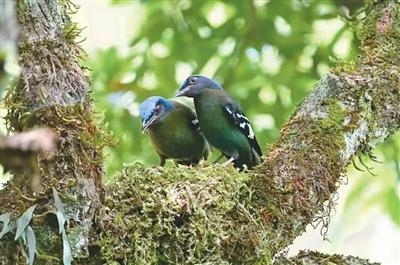
Photo shows green cochoas, a "star" bird species in Napo county, south China's Guangxi Zhuang Autonomous Region. (Photo/Li Jiongchao)
Upon hearing Lin's story, a birdwatcher from Beijing donated 10,000 yuan (about $1,463), with the hope of helping to establish three more bird monitoring sites.
Inspired by enthusiasts like Lin, local communities have embraced bird conservation. Eight bird monitoring sites have been set up in Napo, many managed by villagers.
Ma Zhenjie, a former migrant worker, has returned to his hometown to manage a bird monitoring site, securing both a stable income and more time with his family. For villagers like him who now oversee these monitoring sites, protecting birds has become inseparable from protecting their own homeland.
Why is Napo so rich in birdlife? Jiang Aiwu, a professor at Guangxi University and an expert in avian studies, points to geography.
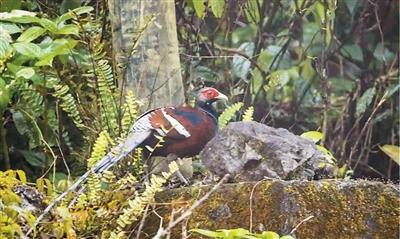
Photo shows a Mrs. Hume's pheasant in Napo county, south China's Guangxi Zhuang Autonomous Region. (Photo/Huang Lichun)
Napo sits at a transition zone where bird species from Southeast Asia reach their northern limit, while species from the Yunnan-Guizhou Plateau extend southward. This overlap creates an unusually diverse mix.
Data show that Napo, an ecologically rich area along the Tropic of Cancer, now boasts a forest coverage rate of 74.92 percent.
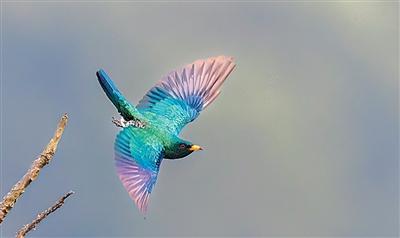
Photo shows an Asian emerald cuckoo in Napo county, south China's Guangxi Zhuang Autonomous Region. (Photo/Lin Xiuwen)
"When I first visited Napo in 2000, its vegetation was still relatively degraded," said Jiang. With stronger ecological protection policies and rising public awareness, the situation has steadily improved. Today, Napo is home to both the Laohutiao Nature Reserve and the Defu Nature Reserve, offering birds a far more stable and suitable habitat.

Tel:86-10-65363107, 86-10-65368220, 86-10-65363106
 Scan the QR Code
 Follow Us