





- BRNN
- BRI News
- BRNN News
- Database
Official Documents Polices and Regulations
Inter-government Documents International Cooperation BRI Countries
Business Guide Economic Data BRI Data
Trade
Investment Projects Latest projects
Cases - Content Pool
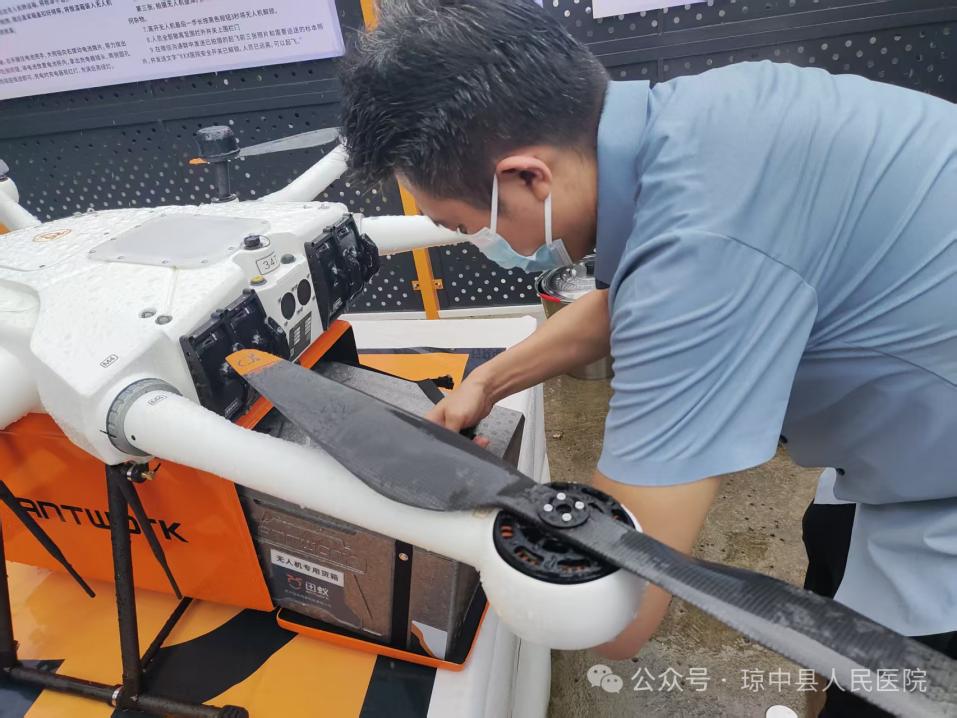
A man puts medicines needed by a township clinic into a drone at Qiongzhong County Central People's Hospital. (Photo provided by Qiongzhong County Central People's Hospital)
In Qiongzhong Li and Miao autonomous county, south China's Hainan province, drones are revolutionizing rural healthcare by transporting medical samples, emergency supplies, and medications between remote villages and county hospitals.
A new low-altitude medical network now connects all 15 township clinics across the county through four drone routes spanning 205 kilometers. Since its launch, medical delivery times have been reduced by 50 percent.
For residents like Cheng Chuanhe from Sihe village in Zhongping township, this innovation has proven life-changing.
When Cheng sought treatment for severe leg cramps at the township clinic, doctors suspected low calcium levels but lacked testing equipment. Previously, this would have required a 60-kilometer mountain journey to the county hospital. "We'll draw your blood here -- the drone will transport it," assured Chen Zhao, the clinic's lab technician.
The announcement immediately set off an aerial relay operation across the mountains.
At a drone station beside Qiongzhong County Central People's Hospital, staff quickly replaced batteries and uploaded pre-flight verification photos. More than 100 kilometers away in Haikou, capital of Hainan province, Lin Shuyu, an operations employee at Dronexpress, a professional drone operation service provider, confirmed that weather conditions and flight routes were clear before tapping a screen to launch the drone remotely.
With a sharp buzz, the drone lifted off and cruised steadily along its pre-programmed route, transmitting real-time data on speed, position, and flight status.
The blood sample reached Zhongping in under 30 minutes. After battery replacement and sample loading, the drone continued to collect additional specimens before delivering all samples to the county hospital within 40 minutes. Two hours later, Cheng received results via provincial health platform: "No calcium deficiency -- just rest and monitor," his doctor advised by phone.
Relieved, Cheng could finally set aside his worries.
The invisible "air corridor" now threading through the mountains is bringing county hospitals and township clinics into much closer coordination, ensuring that medical samples, emergency medicine, and equipment can reach remote communities far more quickly.
Qiongzhong sits within the core ecological area of central Hainan, where mountains and hills account for roughly 80 percent of the terrain. For township residents, complex medical testing once meant either long journeys for patients or time-consuming trips by medical staff to transport samples.
"Previously, we could only ask villagers heading to the county seat to carry samples for us," Chen recalled. "If there was an emergency, we had no choice but to drive all the way ourselves."
While Zhongping township has relatively manageable road conditions, many remote mountain towns face steep roads, sharp curves, and difficult terrain, with a single round trip often consuming most of the day.
The breakthrough came with the explosive growth of China's low-altitude economy.
In April 2025, Dronexpress was established. Following in-depth research, the company set its sights on the medical logistics sector. Only one month later, Hainan's first county-wide full-coverage low-altitude medical logistics project completed its maiden flight.
According to Li Baoming, head of the company's operations department, the network uses Qiongzhong County People's Hospital and Qiongzhong County Traditional Chinese Medicine Hospital as dual hubs. Two drones operate along four intelligent logistics routes linking all 15 township clinics.
Taking into account cost, payload, flight range, and mountain conditions, the company selected drones capable of flying about 30 kilometers per trip with a maximum payload of 9 kilograms.
"The drones are user-friendly for grassroots staff," Li said. "Workers only need to fit the battery before launch, with minimal professional maintenance required. Before official operations, we ran multiple hands-on training sessions for medical personnel. All flights are remotely monitored and intelligently dispatched from our operations center in Haikou."
To improve coverage and efficiency, the drones use a relay-style "leapfrog" system, functioning much like aerial buses that stop along the route for battery swaps and loading before continuing toward county hospitals.
By the end of March this year, Qiongzhong's low-altitude medical logistics network had safely completed 225 flights, covering more than 2,276 kilometers. The breakdown includes 130 trips for routine medical sample delivery, 80 for emergency infectious disease testing, two for emergency medicine transport, and 13 for medical supply delivery.
The success of the project has already drawn attention from across Hainan, with delegations visiting Qiongzhong to study this model. Li and his team are now working to expand the "air corridor" system to more cities and counties across the province.

Tel:86-10-65363107, 86-10-65368220, 86-10-65363106
 Scan the QR Code
 Follow Us