How Hefei's 'Quantum Avenue' became a thriving innovation corridor

Photo shows the office building of the Innovation Center for Quantum Information and Quantum Physics, Chinese Academy of Sciences, in Hefei National High-tech Industry Development Zone, Hefei, capital of east China's Anhui province. (Photo/Ma Erhu)
In Hefei, east China's Anhui province, Yunfei Road within the city's National High-Tech Industry Development Zone is commonly known as "Quantum Avenue."
This ordinary street name belies its extraordinary role as the birthplace of numerous pioneering achievements in quantum technology.
Along this road, the city has produced a series of groundbreaking achievements in quantum technology, including the world's first quantum science experimental satellite Micius, the world's first long-distance quantum secure communication route, the Beijing-Shanghai Backbone Network, and the Jiuzhang series, the world's first generation of photonic quantum computers.
Today, the "Quantum Avenue" is home to more than 30 leading quantum technology companies spanning quantum computing, communication and measurement. Together they form China's most concentrated quantum industry ecosystem.
So how did Hefei build its quantum industry from scratch and grow into a national leader?
The key driver behind this development is the University of Science and Technology of China (USTC).
In June 1998, a research team led by Guo Guangcan at the university initiated China's first Xiangshan Science Conference on quantum information, officially opening the chapter of China's quantum information research in Hefei.
In the years that followed, quantum technology companies began emerging one after another in the city.
In 2009, a team led by Professor Pan Jianwei from USTC founded Anhui Quantum Communication Technology Co., Ltd., China's first company dedicated to the industrialization of quantum technology and the predecessor of QuantumCTek, a globally leading manufacturer of quantum secure communication equipment and provider of quantum security solutions.
Later, companies such as CIQTEK, which focuses on quantum precision measurement, and Origin Quantum, specializing in quantum computing, were established. Other firms including China Telecom Quantum Group, Unitary Quantum and Chinaprosp Quantum also moved into the area.
"Quantum technology requires a very long development cycle from basic research to commercialization and to large-scale application. It is a typical industry characterized by long cycles, high investment, high risk and slow returns," said Wang Mingzhong, an official with Hefei Science and Technology Bureau. "Quantum technology's application scenarios lie in the future, and investing in future industries requires long-term commitment."
The growth trajectory of QuantumCTek offers a clear example.
In 2010, the company participated in building the world's first large-scale quantum communication experimental demonstration network in Hefei. In 2013, it provided products and technical services for the Beijing-Shanghai Backbone Network, the world's first quantum-secured communication trunk line spanning more than 1,000 kilometers. In 2022, it established the Hefei Quantum Metropolitan Area Network, now the largest and most widely covered quantum metropolitan network with the broadest range of applications in China.
Zhou Lei, vice president of the company, spoke frankly about the city's support for the company.
"During our early research, Hefei provided extensive support including office space, funding and coordination," Zhou said. "Later, for large-scale network construction, we needed extensive testing environments. Hefei authorities proactively opened application scenarios, solving an urgent challenge."
Today, QuantumCTek holds more than 1,000 intellectual property rights and has led or participated in the formulation of over 100 domestic and international standards. Hefei has now cultivated and attracted 97 companies in the quantum industry, generating total annual revenue exceeding 6 billion yuan ($880.4 million) and fostering a number of representative industry leaders.
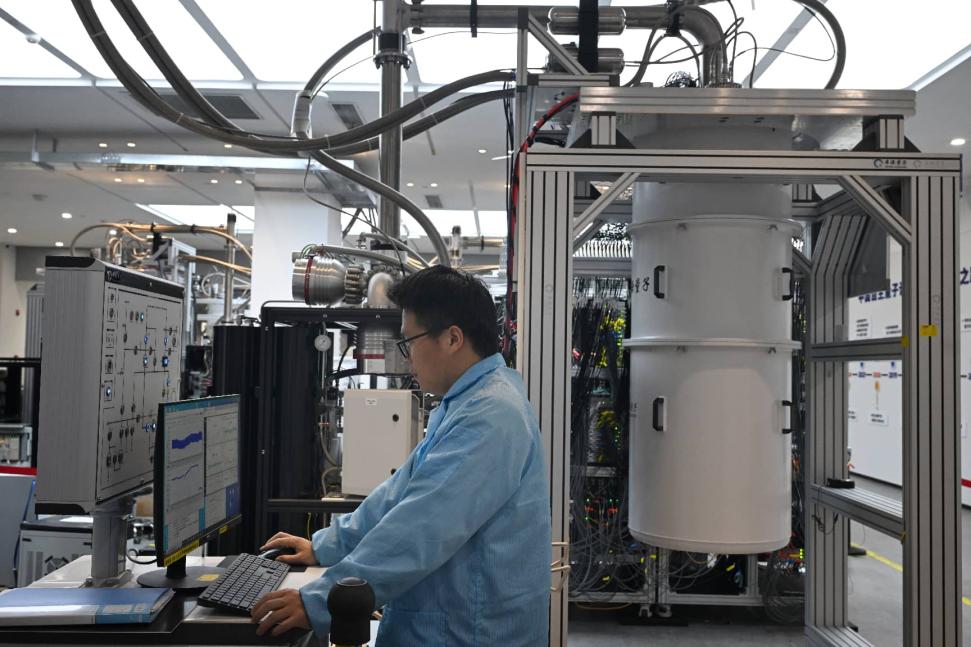
A researcher works with the 4th-generation superconducting quantum computer Origin Wukong-180 at the Anhui Provincial Key Laboratory of Quantum Computing Chips in east China's Anhui province. (Photo Zhang Dagang)
When talking about the booming quantum industry, Lu Chenchen, deputy director of the science and technology bureau of Hefei National High-tech Industry Development Zone, often stresses one principle: riding industrial trends.
"But riding trends does not mean taking a hands-off approach," Lu explained. "It means respecting rules and planning scientifically. It is not about waiting passively, but about taking initiative and planning ahead."
Several years ago, Lu and colleagues discovered a bottleneck in local industrial development. Although Hefei National High-tech Industry Development Zone already had many quantum enterprises, most were positioned in the midstream of the industrial chain. There was a shortage of upstream component manufacturers and downstream application companies.
Earlier this year, Hefei National High-tech Industry Development Zone released an implementation plan for building a pilot zone for future quantum technology industries. The document systematically outlined development goals and industrial planning for the coming years. One major focus is attracting and cultivating upstream enterprises producing key quantum materials and components, as well as downstream application-oriented companies.
Ni Pengcheng, another official with the science and technology bureau, exemplifies the hands-on approach. Carrying his laptop everywhere, Ni states, "I work with quantum-tech companies every day. Having my computer allows me to check data, look up policies, or review documents efficiently."
For Ni, serving enterprises is never trivial. "When companies raise needs, we need to respond quickly and provide targeted services," he said.
He recalled assisting Unitary Quantum during its startup phase. The company needed unfinished office space with convenient transportation access. Upon learning of the request, the bureau coordinated with multiple departments to identify several suitable locations. Officials then accompanied company representatives to inspect each site.
"The process was highly efficient. After just two rounds of visits, the company found a suitable location in Phase I of Anhui Zhong'an Chuanggu Technology Park," Ni said.
As the firm was unfamiliar with project approval and administrative procedures, the bureau also assigned dedicated staff to provide guidance and comprehensive support.
Over the past two years, Unitary Quantum has grown rapidly, with a series of technological breakthroughs. Whenever Ni talks about these achievements, he speaks with visible satisfaction. "Building platforms, providing good services, and helping companies achieve their development goals -- that is what we aim to do," he said.

 Follow Us
 Scan the QR Code
