





- BRNN
- BRI News
- BRNN News
- Database
Official Documents Polices and Regulations
Inter-government Documents International Cooperation BRI Countries
Business Guide Economic Data BRI Data
Trade
Investment Projects Latest projects
Cases - Content Pool
A Chinese research team led by Tianjin University has introduced an innovative solution that gives cultural relics a unique, non-detachable "digital fingerprint," offering a new technological safeguard for cultural relic protection.
The special "fingerprints" refer to the unique surface texture features revealed when relics are magnified to the micrometer level.
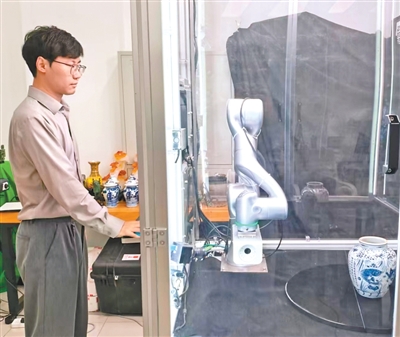
A researcher tests the generation of "digital fingerprints" for cultural relics. (Photo courtesy of Tianjin University's Visual Intelligence Lab)
Tianjin University, in collaboration with multiple institutions, including universities, museums, and cultural heritage institutions, has developed a system that captures microscopic surface features of cultural relics to create unique digital identities, aiming to address long-standing challenges in verifying cultural relics' identity during storage, transport, and exhibition.
"The system is based on the principle that at the microscopic scale, the surface of an object exhibits random physical features. These physically random characteristics at such an observation scale are similar to human fingerprints: they are unique, stable, universally present, and cannot be replicated," explained Feng Wei, a professor in charge of Tianjin University's Visual Intelligence Lab, which spearheaded the project's core technology development.
By magnifying a local point on an object by hundreds of times, down to the micrometer level, it becomes clear that every object has its own distinct physical traits, Feng said.
The system captures images of a cultural relic's microscopic surface features and uses artificial intelligence (AI) algorithms to extract visual data. It then automatically selects key points for encoding to generate the relic's "digital fingerprint."
A key challenge is ensuring that the same points can be identified during future verification.
"In the early stages, this required manual point-by-point alignment. The breakthrough now lies in autonomous repositioning and comparison," Feng said.
"Once the cultural relic is placed on the platform, the equipment and algorithms can automatically locate the corresponding fingerprint area, capture images, extract features and complete identification quickly and accurately, confirming whether 'it is indeed itself,'" Feng added.
Identification of a single point takes less than three minutes, with an accuracy rate exceeding 99.99 percent, according to Feng.
Since 2023, the cultural relic "digital fingerprint" extraction and identification technology has undergone pilot demonstration and validation at the Hunan Museum in Changsha, capital of central China's Hunan Province, and the Chiangnan Watery Region Culture Museum of China in Hangzhou, capital of east China's Zhejiang Province.
"By comparing the microscopic visual characteristics collected before and after circulation, the system enables highly precise identity verification, providing strong technical support for ensuring the security of cultural relics during storage, transportation and touring exhibitions," said Duan Xiaoming, curator of the Hunan Museum.
The museum plans to register "digital fingerprints" for more than 1,000 cultural relics, according to Duan.
Backed by the country's national key research and development program project on key technologies for "digital fingerprint" extraction, identification and intelligent identity management of museum collections, the cultural relic "digital fingerprint" extraction and identification system has shifted relic identity verification from subjective human judgment to objective technological verification.
Traditionally, cultural relic management has relied heavily on expert judgment, manual records, and physical tags such as labels or seals.
While digital tools like QR codes and radio frequency identification (RFID) chips have improved tracking efficiency, they remain externally attached and can be separated from the object itself, leaving potential security gaps.
Using non-contact imaging systems coupled with AI algorithms, the new system eliminates the need for physical markers and ensures that identity verification is intrinsically bound to the object itself.
It helps museums effectively counter professional forgery and fraudulent substitution, while enabling rapid identity verification across diverse relic circulation and exhibition activities.
The "digital fingerprint" system evolved from the team's earlier research in intelligent visual sensing, originally designed to monitor subtle changes in cultural relics over time.
Many cultural relics suffer from slow, long-term deterioration caused by humidity fluctuations, material aging, microbial activity, and environmental stress. These changes often develop gradually and are difficult to detect in their early stages.
To address this, the research team developed an intelligent spatiotemporal visual sensing system for complex cultural relic environments.
Described by researchers as a "doctor for cultural relics," the system is capable of tracking minute structural changes at the microscopic level.
By comparing new images with historical data—even century-old photographs—the system can reconstruct imaging conditions and precisely align observations for accurate comparison.
The intelligent spatiotemporal visual sensing technology is capable of detecting surface changes at a resolution of around 10 micrometers, roughly one-seventh the diameter of a human hair.
The system has been deployed in more than 50 major cultural heritage sites and museums across China, including the Mogao Grottoes, the Palace Museum, the Summer Palace, the Emperor Qinshihuang's Mausoleum Site Museum, and the Maijishan Grottoes.

Tel:86-10-65363107, 86-10-65368220, 86-10-65363106
 Scan the QR Code
 Follow Us