





- BRNN
- BRI News
- BRNN News
- Database
Official Documents Polices and Regulations
Inter-government Documents International Cooperation BRI Countries
Business Guide Economic Data BRI Data
Trade
Investment Projects Latest projects
Cases - Content Pool
Industry-oriented culinary schools dedicated to turning fragmented folk cooking skills and local know-how into standardized, scalable vocational training programs are gaining momentum across China.
In recent years, the commercialization of regional specialty cuisines has driven the growth of specialized culinary schools.
This year alone, the country has seen the establishment of a number of such schools, which have quickly gained popularity, covering regional delicacies including shaomai (a type of steamed dumpling), skewers, laziji (spicy chicken) and sour soup.
Providing both vocational education and short-term skills training, these schools cater to the needs of different groups of people, highlighting a broader trend of formalizing once-informal food traditions into structured training pipelines that feed directly into employment and industry.
Hands-on training in standardized production and business management
Inside these schools, students do not simply learn recipes; they are trained through full production chains under strict standards.
At the Wanzhou grilled fish training center under Artificer College of Wanzhou in southwest China's Chongqing Municipality, students begin their training not in a classroom, but at a live fish market.
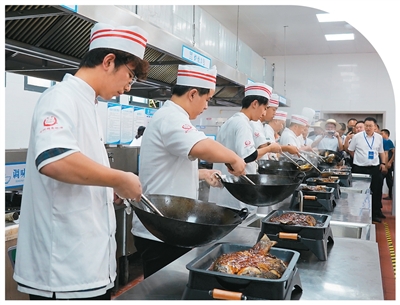
Trainees attend a practical cooking class at the Wanzhou grilled fish training center under Artificer College of Wanzhou in southwest China's Chongqing Municipality. (Photo courtesy of the interviewee)
"If a fish is too fatty, it can feel greasy; if it's too lean, it won't be flavorful enough. That's why the very first lesson is to teach students how to choose a fish with good flesh," said Jian Mingwu, an instructor at the training center.
"Identifying fish species, judging freshness and checking its overall condition are the essential basics for making a good grilled fish," Jian added.
Students then progress through the entire production process, from selection to cutting, marinating, grilling and seasoning. Each step is broken down into standardized procedures.
One student noted that even knife cuts must follow strict spacing requirements, while another described how different chili varieties and Sichuan pepper types must be carefully distinguished for flavor balance.
Similar standardization is being introduced elsewhere. At Yueyang Barbecue College in Yueyang, central China's Hunan Province, ingredient preparation and seasoning ratios are quantified down to the gram, replacing traditional experience-based cooking with measurable processes.
The goal of these culinary schools is to develop versatile professionals skilled in both technical practice and business management, according to Zhang Jing, president of Artificer College of Wanzhou.
"In addition to learning how to prepare grilled fish, degree-program students are also required to systematically study Sichuan cuisine, Jianghu-style dishes, as well as courses in restaurant operations, food safety and nutritional balance," Zhang said.
Traditional culinary skills have long been passed down through oral instruction from master to apprentice, which can result in inconsistent standards, inefficient training and a shortage of skilled workers. Industry-oriented culinary training programs are helping address these challenges, according to experts.
Guidance from veteran chefs and experienced business managers
Many of the instructors at these culinary schools are head chefs from star-rated hotels, inheritors of intangible cultural heritage and experienced managers from food service companies. They bring together formal education, culinary expertise and industry experience.
Liu Xuming, lead instructor at the shaomai industry-oriented college under Hohhot Commerce and Tourism Vocational School in Hohhot, north China's Inner Mongolia Autonomous Region, is a graduate who returned to teach at his alma mater after honing his skills at a large catering enterprise.
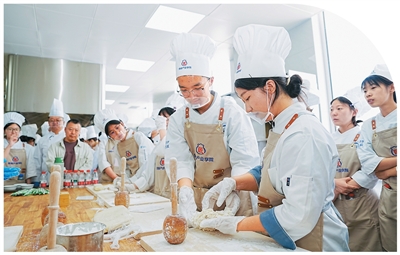
Students from the shaomai industry-oriented college under Hohhot Commerce and Tourism Vocational School in Hohhot, north China's Inner Mongolia Autonomous Region, visit a local food company in Hohhot to learn from its chefs, June 2, 2026. (Photo courtesy of the interviewee)
In collaboration with other instructors, he has broken down century-old shaomai-making techniques into 12 standardized production steps.
At the Wanzhou grilled fish training center, culinary master Jian Mingwu has developed new grilled fish flavors such as curry, black pepper and Thai-style tom yum goong, helping promote the dish in overseas markets.
Bai Zuoteng, senior executive of a food technology company, has been appointed dean of a college for the local sour soup industry under Qiandongnan Nationalities Polytechnic in Kaili city, Qiandongnan Miao and Dong Autonomous Prefecture, southwest China's Guizhou Province.
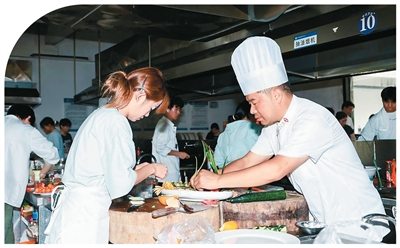
Students from a college for the local sour soup industry under Qiandongnan Nationalities Polytechnic in Kaili city, Qiandongnan Miao and Dong Autonomous Prefecture, southwest China's Guizhou Province, learn culinary techniques from experienced practitioners in Kaili. (Photo courtesy of the interviewee)
Based on his practical experience, Bai has integrated fermentation science, production know-how and digital marketing into his teaching.
"The specialists from enterprises on the teaching team integrate production standards and operational norms into daily practical training, enabling students to precisely meet market demand and making them highly sought after by employers," Liu said.
Bright employment prospects for graduates
One of the defining features of these culinary schools is their close integration with industry employers.
The sour soup industry-oriented college in Guizhou has established partnerships with 15 leading enterprises, according to Jiang Youcai, vice president of Qiandongnan Nationalities Polytechnic.
"By engaging in the training of students through employer-oriented classes and jointly building training centers, enterprises participate throughout the entire process of student training and employment, enabling students to have their career pathways effectively defined upon enrollment," Jiang said.
According to Liu Xuming, executives of a well-known shaomai company were impressed by promising students during a shaomai-making competition organized by the shaomai industry-oriented college and said they would be glad to hire candidates who have received systematic training.
In central China's Hubei Province, a crayfish industry-oriented school has seen near-100 percent employment rates among graduates, with many students receiving multiple job offers before graduation.
"The baking industry has a strong demand for talent. By the time each trainee is about to graduate, they can usually receive two to three suitable job offers," said Xiao Peng, director of the baking training center at a baking industry-oriented college in Zixi county, Fuzhou city, east China's Jiangxi Province.
"We build employment platforms based on school-enterprise collaboration, allowing both students and partner companies to make mutual selections. Many outstanding students are even hired before graduation," Zhang said.
Driving industrial upgrading and rural development
Beyond employment, officials and educators say these schools are playing a broader role in regional industrial development.
In Guizhou, the rapid rise of the signature sour soup has been boosted by the popularity of rural cultural events. This has helped drive the industry's total output value to over 8.15 billion yuan ($1.21 billion) in 2025, marking a 221-percent year-on-year increase.
The sour soup industry-oriented college, established amid the industrial boom, has also developed culinary-themed tourism routes linking training centers, ethnic villages and intangible cultural heritage workshops, creating integrated food and tourism experiences.
In Chongqing, the Wanzhou grilled fish training center has launched an online platform that supports training, entrepreneurship guidance, recruitment, shop transfers and raw material sourcing.
The laziji industry-oriented college in Zaozhuang city, east China's Shandong Province, covers the full value chain, from agriculture and food processing to tourism and branding. This provides strong support for the local laziji industry, which sees an annual output value of over 5 billion yuan.
These specialized culinary schools are emerging as key drivers of local economic development, according to industry insiders.
They noted that the establishment of these culinary schools not only helps train large numbers of professionals but also drives the development of supporting industries such as ingredient supply, equipment leasing, brand franchising and cultural tourism.

Tel:86-10-65363107, 86-10-65368220, 86-10-65363106
 Scan the QR Code
 Follow Us