





- BRNN
- BRI News
- BRNN News
- Database
Official Documents Polices and Regulations
Inter-government Documents International Cooperation BRI Countries
Business Guide Economic Data BRI Data
Trade
Investment Projects Latest projects
Cases - Content Pool

Drones spray pesticide on a wheat field in Zhangye, northwest China's Gansu province. (Photo/Wang Xiaojing)
This year commemorates two key milestones: the 40th anniversary of China's systematic, large-scale poverty alleviation initiatives and the 30th anniversary of its poverty alleviation cooperation and pairing assistance between its eastern and western regions.
Drawing on insights from global scholars and experts, it is evident that China has successfully addressed one of humanity's most persistent development challenges -- extreme poverty. The nation's pioneering achievements in poverty reduction have earned international recognition, offering practical, evidence-based solutions to advance poverty governance worldwide.
Over recent decades, China has lifted over 800 million people out of poverty, an unprecedented accomplishment in history.
Hassan Daud Butt, a scholar from Pakistan's Sustainable Development Policy Institute, highlighted China's commitment to a people-centered approach and forged a path to poverty reduction that diverges significantly from traditional Western aid frameworks.
Beyond economics, China's victory over extreme poverty represents a major advance in global human rights. It substantially improved living conditions across essential domains like food access, housing, transportation, education, healthcare, and employment, while ensuring the fundamental right to development.
Chea Munyrith, president of the Cambodian Chinese Evolution Researcher Association, observed that China's anti-poverty theory evolved from one-way assistance to fostering self-sustaining development capacity.

Photo shows a relocation site for poverty alleviation in Chengbu Miao autonomous county in Shaoyang, central China's Hunan province. (Photo/Yan Qinlong)
By integrating poverty relief with efforts to boost people's self-motivation and practical skills, China has avoided the pitfalls of dependency seen in traditional welfare models.
Its experience delivers an important global lesson: poverty reduction cannot rely solely on external assistance but requires long-term mechanisms that empower individuals and unlock local vitality.
"China has deeply recognized that poverty stems from a combination of factors, including inadequate infrastructure, limited access to education and health care, and underdeveloped market systems," said Evandro Menezes de Carvalho, professor at the Fluminense Federal University in Brazil and an expert on international affairs.
He noted that a key factor behind China's success was elevating poverty reduction to the level of a national strategy and advancing coordinated efforts in industrial development, regional cooperation, and cultural progress.
Butt emphasized "targeted poverty alleviation" as China's principal innovation: a data-driven method focusing on precise identification of poor households, tailored support, and robust monitoring. This approach optimized resource allocation while improving urban-rural infrastructure, logistics, market access for rural industries, and employment skills for low-income groups.
China achieved the poverty reduction target of the United Nations 2030 Agenda for Sustainable Development 10 years ahead of schedule and has contributed to over 70 percent of the poverty reduction across the world. As a result, it has become an important benchmark in global poverty governance.
Global experts universally acknowledge that China has made major contributions to global poverty reduction and sustainable development in both theory and practice, generating lasting benefits for developing countries around the world.
On May 27, at the 2026 Global Poverty Reduction and Development Forum, China, together with 53 countries and nine international organizations, jointly launched the Global Partnership for Poverty Alleviation and Development. The initiative marks an important step forward for the international cause of poverty reduction.
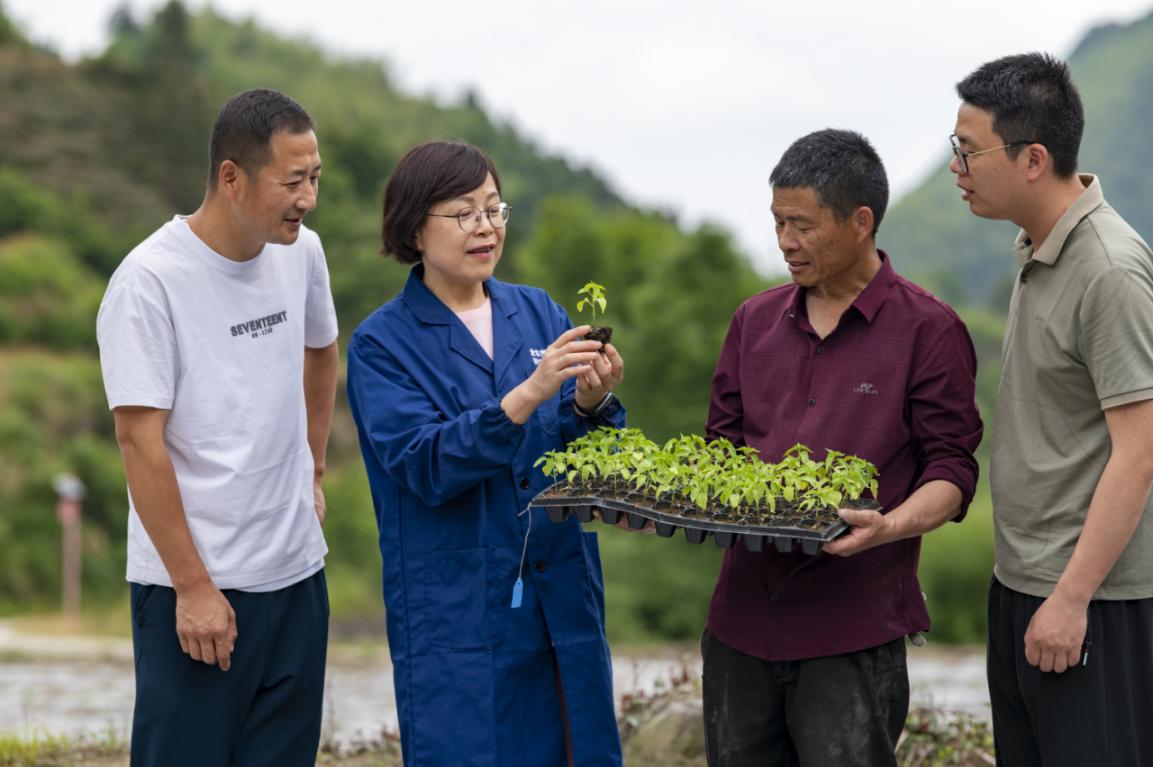
An agricultural expert (middle) is dispatched to the countryside to offer guidance on chili pepper planting in Ruoyang township, Jinhua, east China's Zhejiang province. (Photo/Hu Xiaofei)
Going forward, the alliance will serve as an efficient platform for cooperation, facilitating regular exchanges of poverty reduction experience, practical technologies, and talent development programs, while helping China's experience reach a broader global audience.
China's Juncao, a hybrid grass originally developed in China for mushroom cultivation, has been promoted internationally for more than three decades. In 2017, it was incorporated into key projects under the China-United Nations Peace and Development Fund, and it has since been introduced to more than 100 countries and regions worldwide.
Lin Zhanxi, professor at Fujian Agriculture and Forestry University and inventor of the Juncao technology, stated that in international Juncao cooperation, China promotes technological localization, simplification and standardization, enabling disadvantaged communities to participate more easily in development initiatives.
Aligned closely with objectives such as poverty reduction and job creation, these projects have improved local livelihoods and won broad recognition across the developing world.
Felix Dapare Dakora, fellow of the African Academy of Sciences and Senior Adviser to the National Nanfan Research Institute of the Chinese Academy of Agricultural Sciences, noted that China has consistently shared its poverty reduction experience with Africa through multiple channels while deepening practical cooperation.
China has established more than 20 agricultural technology demonstration centers across Africa, introduced over 300 agricultural technologies, and carried out programs in improved seed dissemination, agricultural machinery application, and technical training. China and African countries have also pioneered poverty reduction demonstration villages that integrate infrastructure development, industrial growth, and public services at the village level, creating models that can be replicated and scaled up elsewhere.
"China has not only charted an effective path out of poverty for itself," Dakora said, "but has also transformed its experience into an important global public good, contributing to global poverty governance and the shared development of humanity."

Tel:86-10-65363107, 86-10-65368220, 86-10-65363106
 Scan the QR Code
 Follow Us