





- BRNN
- BRI News
- BRNN News
- Database
Official Documents Polices and Regulations
Inter-government Documents International Cooperation BRI Countries
Business Guide Economic Data BRI Data
Trade
Investment Projects Latest projects
Cases - Content Pool
"During our cooperation over the past 10 years, there has not been a single quality issue or breach of contract. Muze has always shown me the professionalism and sense of responsibility Chinese enterprises maintain," said Linda, manager of Chilean company Imp A&Z SpA.
Linda, who partners with the Chinese enterprise, has nothing but praise for Baoding Muze Textile Co., Ltd., a manufacturer specializing in towels, home textiles, and cotton products.
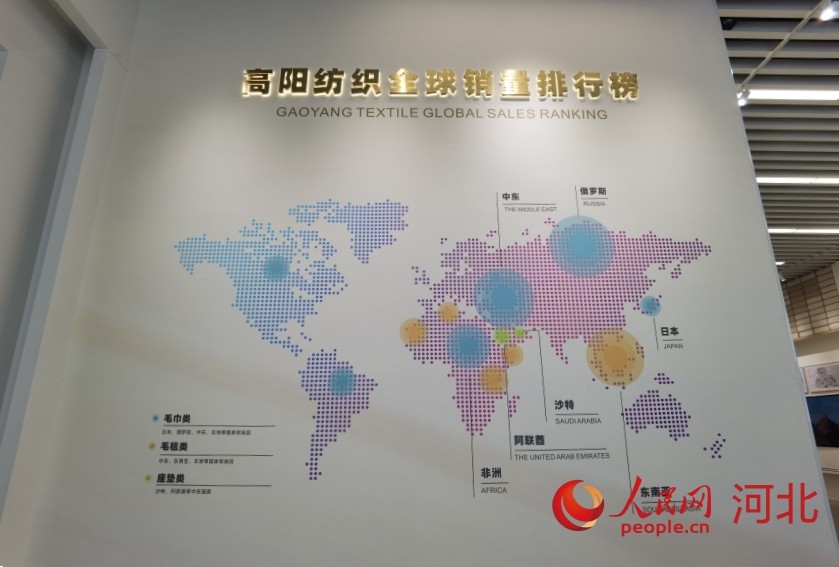
Photo shows the global sales ranking of textile products from Gaoyang county, Baoding city, north China's Hebei Province. (People's Daily Online/Zhu Yansheng)
Since their initial contact at the China Import and Export Fair, also known as the Canton Fair, in May 2016, the two companies have built an increasingly close bond, with their business collaboration starting from a half-container trial order and expanding to a long-term strategic partnership with stable monthly shipments of three to five containers.
More than a story of successful cooperation between two companies, the partnership reflects the foreign trade prospects within Gaoyang county, known as China's "towel capital," in Baoding city of north China's Hebei Province, where enterprises have been striving to build global trust on integrity and quality.
Ten years ago, when Baoding Muze Textile’s exhibition booth caught her eye at the Canton Fair, Linda was impressed by the softness, absorbency, craftsmanship, and competitive pricing of its towels, but didn't place an order immediately due to concerns about quality and the reliability of after-sale services.
Sensing her hesitation, Han Chao, general manager of Baoding Muze Textile, made a direct promise. "Regardless of the size of the order, even if it is just a single unit, and if there are any quality issues, we will provide immediate compensation, or replacement, and take full responsibility throughout the entire process."
This commitment established the beginning of a trustworthy business collaboration. Linda then placed a sample order for half a container. When the shipment arrived in Chile, it was flawless. Zero defects and zero complaints.
As their commercial partnership has expanded steadily over the following decade, Linda now comes to visit Gaoyang every two to three years to inspect production lines and quality systems firsthand, witnessing how Baoding Muze Textile has been transformed from a traditional workshop into an intelligent, digitalized, and standardized modern textile manufacturer.
Inside the modern production facility of Baoding Muze Textile, rows of jet looms operate in synchronized precision, while workers monitor processes through control systems rather than manual intervention.
Intelligent inspection equipment automatically scans towel loop uniformity, color fastness, and tensile strength, instantly removing any substandard products from the line.
"This is an advanced production model I have never seen in Chile," the Chilean buyer remarked.
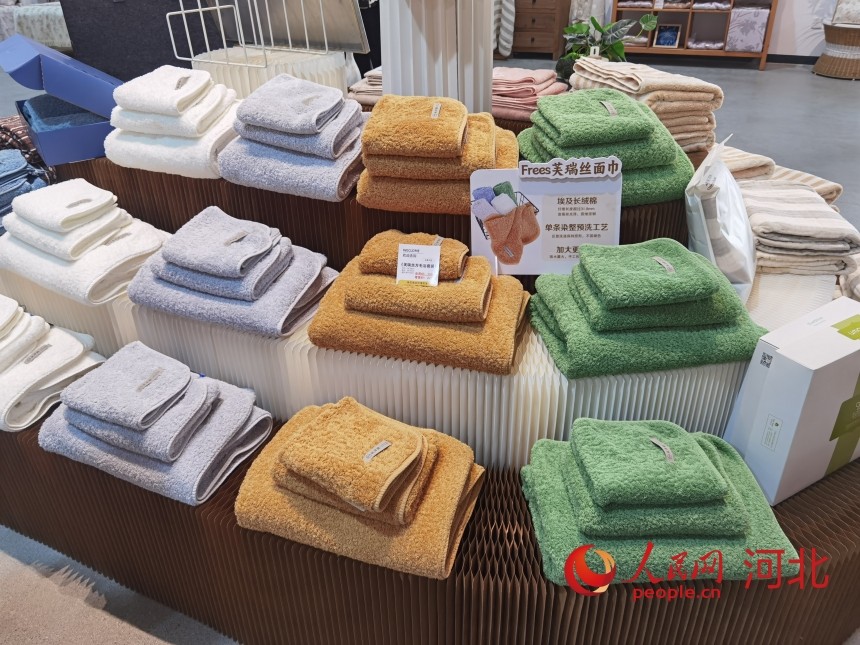
Photo shows towels produced in Gaoyang county, Baoding city, north China's Hebei Province. (People's Daily Online/Zhu Yansheng)
What impressed Linda even more is Gaoyang's complete industrial ecosystem, where more than 4,200 enterprises, covering every link of the industrial chain from spinning to weaving, dyeing, testing, and logistics, work in coordinated synergy, forming a "30-minute supply chain circle."
In this "towel capital" with a local supporting rate of the industrial chain of 89 percent, every step from raw material procurement and production to shipment can be completed in a one-stop process.
Quality is a paramount priority for the business ecosystem. In Gaoyang, each towel for export undergoes an eight-step quality control process, covering raw material testing, weaving, shaping, eco-friendly dyeing, dehydration and drying, precision cutting, finished inspection, and packaging.
More than 10 indicators are tested in the inspection stage alone, including absorbency, color fastness, and chemical safety.
As a result, one out of every three towels in China comes from Gaoyang, and a towel now goes from cotton yarn to finished product in just 3 hours in the county.
"It's not just that one company is reliable, but that the entire city and the whole industry are trustworthy," Linda said. She added this is precisely what reinforces the confidence for her continued increase in orders.
The global success of towels from Gaoyang is an epitome of the broader rise of Hebei Province's specialized industrial clusters.
In recent years, Hebei has strengthened support for its county-level economies and developed globally recognized signature industries, such as the towel industry in Gaoyang county, chestnut industry in Qinglong Manchu Autonomous County, and steel industry in Qianxi county.
The province now hosts 24 national-level specialized industrial clusters for small and medium-sized enterprises (SMEs) and 107 key industrial clusters, forming a development model driven by leading enterprises, coordinated supporting firms, collaboration-based innovation, and integrated growth.
In Gaoyang, local authorities have supported shared manufacturing facilities, smart testing centers, and cross-border e-commerce platforms, encouraging enterprises to expand overseas collectively.
Meanwhile, the China-Europe freight train network operating from the Shijiazhuang International Land Port, located in Shijiazhuang, capital of Hebei, now connects more than 50 countries via 18 international routes, providing stable logistics channels for Hebei-made products to reach global markets.
"I will continue to deepen our cooperation and bring more high-quality products from Hebei into households across Chile, so that more people can experience the appeal of Chinese manufacturing," Linda said.

Tel:86-10-65363107, 86-10-65368220, 86-10-65363106
 Scan the QR Code
 Follow Us