





- BRNN
- BRI News
- BRNN News
- Database
Official Documents Polices and Regulations
Inter-government Documents International Cooperation BRI Countries
Business Guide Economic Data BRI Data
Trade
Investment Projects Latest projects
Cases - Content Pool
The Shaanxi Hanzhong Crested Ibis National Nature Reserve in Hanzhong, northwest China's Shaanxi Province, runs an artificial breeding center where thousands of square meters of semi-wild enclosures replicate the bird's natural wetland habitat. There, captive-bred crested ibises perch and forage.
Known as the "oriental gem," the crested ibis depends on both wetland and forest ecosystems for survival and is considered a key indicator of ecological health.
After more than 40 years of conservation efforts, the global crested ibis population had surpassed 12,000 by the end of 2025, with its habitat expanding to over 20,000 square kilometers.
Gao Jie, director of the breeding center, said the enclosures are mainly used to train the birds in natural survival skills such as breeding and foraging, helping preserve their wild instincts. The center has hatched more than 50 chicks so far this year.
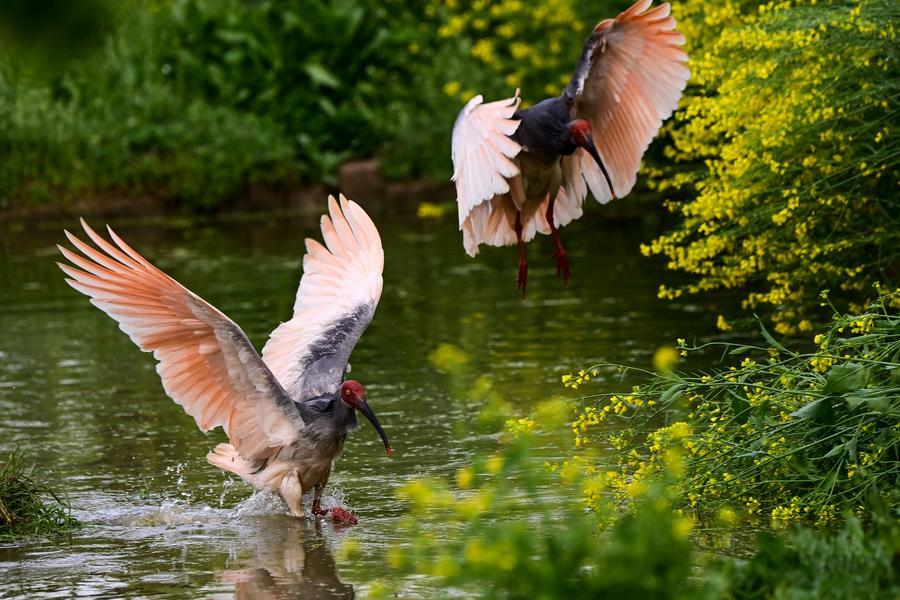
Crested ibises forage at a pond in Caoba village, Yangxian county of northwest China's Shaanxi Province, March 30, 2026. (Xinhua/Zou Jingyi)
Once widely distributed, the crested ibis virtually disappeared in the last century due to deforestation, pollution, wetland destruction and hunting.
In May 1981, a research team led by Liu Yinzeng of the Institute of Zoology under the Chinese Academy of Sciences discovered seven wild crested ibises in Yaojiagou, Yangxian county, Hanzhong. That same year, the local government banned hunting and tree felling, and called on residents to help protect the birds.
"In the early years, the birds nested in trees while researchers lived beneath them, recording their feeding, egg-laying and incubation habits day after day to better understand their breeding behavior," Gao said.
In 1991, the Shaanxi Crested Ibis Rescue and Breeding Center was established to care for injured and sick wild birds. Rehabilitated individuals were then used in captive-breeding research.
"In 1993, we achieved the first successful artificial incubation of a crested ibis," Gao said. The breakthrough laid the foundation for restoring wild populations, and by 2000, the captive population had surpassed 100 birds. Returning the species to its historical range then became the next conservation goal.
Today, wild crested ibis populations are established in all 10 prefecture-level cities of Shaanxi and have spread to 15 provincial-level regions across China, steadily reclaiming their historical range.
Thanks to its unique ecological advantages as a crested ibis habitat, Caochiwan village has become a popular rural tourism destination.
Zhou Fakui, 79, was among the first villagers to join local conservation efforts after two crested ibises settled in a tree outside his home.
"Some villagers used to worry that the birds would eat loaches and small fish in the fields and affect harvests. Later, village officials explained that the crested ibises came because our environment was in good condition," Zhou said.
To keep the birds around, villagers voluntarily worked to protect the local ecosystem. Today, more than 70 crested ibises reside in the village year-round.
Improved ecological conditions have also fueled the growth of rural tourism. Caochiwan village has adopted a model combining the village collective, tourism companies, cooperatives and local households, and used it to transform vacant homes into B&Bs and birdwatching tea houses. This has created new sources of income.
"Since the birdwatching tea house opened in 2023, I no longer need to work away from home and can stay close to care for my parents and children," said Zou Jingge, who runs the tea house. "The cleaners and kitchen staff are all local residents, each earning around 3,500 yuan ($516) a month."

Tel:86-10-65363107, 86-10-65368220, 86-10-65363106
 Scan the QR Code
 Follow Us