





- BRNN
- BRI News
- BRNN News
- Database
Official Documents Polices and Regulations
Inter-government Documents International Cooperation BRI Countries
Business Guide Economic Data BRI Data
Trade
Investment Projects Latest projects
Cases - Content Pool
Dalang, a town of less than 100 square kilometers in Dongguan city, south China's Guangdong Province, produces about 900 million sweaters a year, roughly one in every five sweaters made worldwide.
The town's complete sweater industrial chain generates annual trade of more than 72 billion yuan ($10.6 billion).
At the Dalang Knitwear Trade Center, Zhang Jiankai, head of a supply chain management company, recently used the Dongguan Market Procurement Trade Network Information Platform to ship a batch of women's sweaters to an Australian buyer.
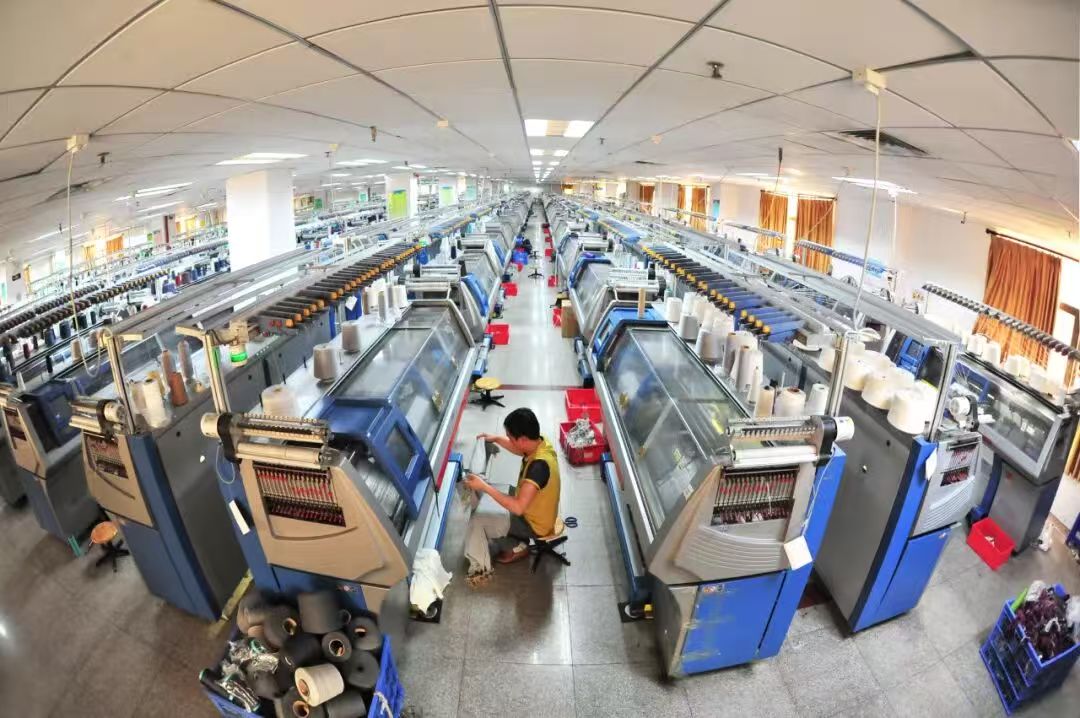
Photo shows a factory in Dalang, Dongguan, south China's Guangdong Province. (Photo/China Economic Weekly)
Zhang and many other industry veterans who have worked in the town for more than a decade credit Dalang's rise to its complete local supply chain. Raw materials, skilled workers and designers are all within a few kilometers, and the town's export channels reach more than 160 countries and regions.
Zhong Jinfa, an official in Dalang, said the town's knitwear industry began in the late 1970s. Over the past 40-plus years, competition has pushed the sector toward digital upgrading, backed by local government subsidies for equipment upgrades and model factories. The town's factories now operate 150,000 flat knitting machines, including more than 10,000 advanced computerized models.
At the China Dalang Woolen Knitwear Fair, held from June 24 to 26, an AI-powered design tool drew attention. Trained on a database of more than 2 million knitwear patterns, it lets designers generate multiple design options in one to two minutes by entering keywords, cutting design costs by more than 60 percent.
Combined with smart manufacturing, the tool has cut prototyping time from three days to two hours, enabling flexible, made-to-order production in Dongguan and helping innovative designs quickly become bestsellers.
Dongguan Tongfa Knitwears Co., Ltd. is betting on quality over volume. "Dalang's knitwear industry is shifting away from labor-intensive, high-volume production. Our company, for example, has focused on the high-end segment, with sales growing 20 to 30 percent a year," said Liu Dianyu, the company's chairman. About 70 percent of its products are exported to Europe and the U.S., with unit factory prices of $25 to $30.
"Sweaters today are worn for fashion, not just warmth," said Liu, who has built a design team of more than 100 people, or a third of the company's staff. Research and development accounts for half of total costs, and the company plans to open a design studio in Europe.
Innovation is also extending to materials. Firms in Dalang develop nearly 10,000 new yarn products each year. They hold more than 200 yarn-related patents, with fancy-yarn patents accounting for roughly two-thirds of China's total.
"Driven by advances in technology, business models and materials, Dalang's knitwear industry is accelerating its move up the value chain," said Ye Jianfen, deputy head of Dalang town.
Policy support has helped smaller traders reach global markets. Since 2020, Dalang has piloted a "market procurement trade" model that simplifies customs declarations and exempts small, mixed-category orders from value-added tax invoicing, with a cap of $150,000 per customs declaration, according to Liu Haojiang, head of the Dalang Market Procurement Trade Service Center.
"For a small trading company like ours to sell sweaters to 30 or 40 countries, we've relied heavily on a good business environment and thoughtful policy support, especially the simplified export procedures and improved services," Zhang said.
The model now covers categories beyond wool products, including footwear, luggage, plastics, toys and hardware.
As of July 18, Dalang's market procurement exports this year had reached 13.11 billion yuan, with cumulative exports of 220.06 billion yuan reaching buyers in 225 countries and regions.
"We'll continue supporting the healthy growth of new trade models, including market procurement trade," said Liu Rui, a local customs officer, adding that the goal is to help more Chinese-made knitwear reach global markets.

Tel:86-10-65363107, 86-10-65368220, 86-10-65363106
 Scan the QR Code
 Follow Us