





- BRNN
- BRI News
- BRNN News
- Database
Official Documents Polices and Regulations
Inter-government Documents International Cooperation BRI Countries
Business Guide Economic Data BRI Data
Trade
Investment Projects Latest projects
Cases - Content Pool
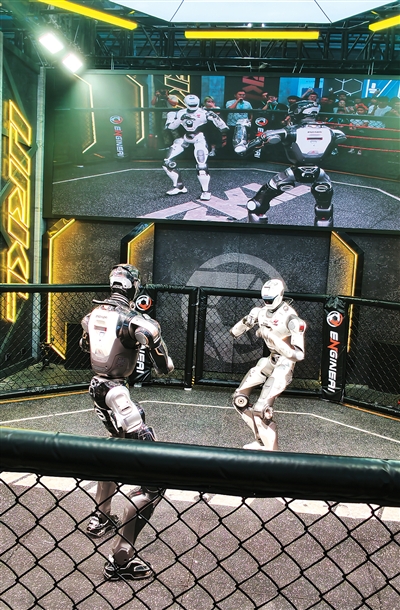
T800 humanoid robots of EngineAI Robotics demonstrate robot combat for visitors at the 2026 World Robot Conference on Aug. 20, 2026. (People's Daily Overseas Edition/Yang Junfeng)
The 2026 World Robot Conference (WRC) was held in the Beijing Economic-Technological Development Area (Yizhuang) from Aug. 19 to 23, drawing 373 companies showcasing 3,000 innovative products, including 311 new releases.
Unlike past years, when exhibitors focused on robots' ability to run and jump, this year's show emphasized humanoid robots' capacity to perform practical tasks — inspecting facilities, sorting goods, folding laundry and cooking — as the technology moves from lab demonstrations toward commercial and household use.
Zhang Feng, chairman of the China Humanoid Robotics and Embodied Intelligence Committee of 100, said China's humanoid robot shipments exceeded 40,000 units in the first half of 2026, accounting for 97 percent of the global total, as the industry shifts from small-scale trials toward routine, large-scale deployment.
At the booth of Robbyant, a robotics company under Ant Group, a robotic arm fulfilled a simulated pharmacy order, retrieving medicine from shelves in one fluid motion — a system staff said is meant to ease staffing pressure at busy pharmacies, freeing pharmacists to counsel customers rather than move back and forth between the register and shelves. Robbyant's robots already sort medication at several outlets of Sinopharm of Shanghai without requiring changes to store layouts.
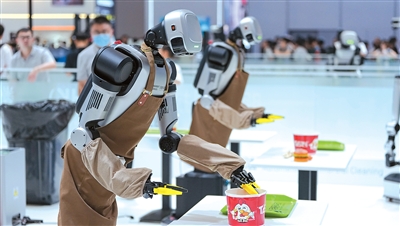
A company's humanoid robots clean at the 2026 World Robot Conference. (Xinhua/Ju Huanzong)
Humanoid robots are also proving useful in hazardous settings. At the Beijing Humanoid Robot Innovation Center's booth, a Tiangong robot used a thermal imaging device to inspect electrical control cabinets — work that can pose safety risks to people in high-voltage areas.
Xu Jingyi, the center's energy product line director, said Tiangong combines the center's embodied intelligence platform with State Grid's Guangming power large model to navigate complex environments and carry out precise inspections. The robot has been tested at substations in places including Beijing, and the provinces of Sichuan and Zhejiang.
On factory floors, robots are also learning to collaborate. At the booth of humanoid robot maker UBTECH, nearly 10 Cruzr Y1 and Cruzr S2 humanoid robots worked in tandem on a mock production line, loading and unloading automotive sheet metal and machined parts and independently stacking material boxes.
Jiao Jichao, UBTECH's vice president and head of its institute for embodied intelligence and humanoid robots, said the shift from single-robot autonomy to multi-robot collaboration means moving to a coordinated multi-robot system capable of task scheduling and automatically taking over when one unit fails.
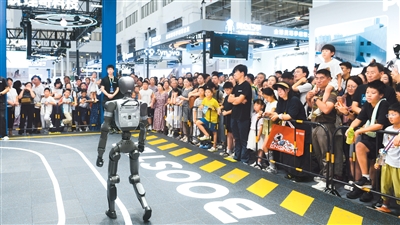
Visitors watch a performance by a humanoid robot of Booster Robotics at the 2026 World Robot Conference. (Photo/Liu Yang)
Jiao added that the company has deployed a dual-loop AI system (BrainNet 2.0 and Co-Agent), which allows multiple humanoid robots to undergo coordinated group training in real-world factory settings.
Humanoid robots are also finding a role at home. At the booth of Haier, a household robot called Haiwa picked up a T-shirt, loaded it into a washing machine and pressed start, while a second unit sorted groceries, placing items needing refrigeration in the fridge.
Li Xin, head of Haier's embodied intelligence research and development, said the company's home robots currently focus on a few common chores rather than trying to replace all household tasks, to prove their practical value and reliability before adding functions.
Price remains a hurdle for wider adoption, prompting companies to explore rental models. At the booth of Futuring Robot, an F2 robot drew a crowd by cooking a pasta dish in seven steps without human help.
Co-founder Shen Luyi said the robot rents for 3,000 yuan (about $446.41) a month, is already used in more than 500 households, and has logged over 50,000 hours of service, handling cleaning, security and even games like chess in response to user feedback.
Some robots are shifting from tools to companions. UBTECH's hyper-realistic U1, with lifelike silicone skin capable of dozens of subtle facial expressions, drew particular attention. Powered by its "Resonance-LM" emotion model, it can recognize a user's mood and respond accordingly. Jiao said such robots could eventually support elderly people through companionship and mental health care.
At the 2026 WRC, e-commerce giant JD.com showcased a robot repair program, saying it has built a network with leading manufacturers offering in-home repair services, after customers previously had to ship faulty robots back to factories. JD.com operates eight robot service centers nationwide, covering categories including humanoid robots, quadruped robots and AI companion robots, and plans to expand door-to-door repairs to more than 50 major cities within three years.

Tel:86-10-65363107, 86-10-65368220, 86-10-65363106
 Scan the QR Code
 Follow Us