





- BRNN
- BRI News
- BRNN News
- Database
Official Documents Polices and Regulations
Inter-government Documents International Cooperation BRI Countries
Business Guide Economic Data BRI Data
Trade
Investment Projects Latest projects
Cases - Content Pool
NANNING, Sept. 16 (Xinhua) -- China opened the Pinglu Canal on Wednesday, giving its landlocked southwest a shortcut to the coast and overseas markets, particularly those in the Association of Southeast Asian Nations (ASEAN), the country's largest trading partner.
Built at a cost of 72.7 billion yuan (about 10.75 billion U.S. dollars), the 134.2-kilometer canal runs from Hengzhou, a county-level city in south China's Guangxi Zhuang Autonomous Region, to the Beibu Gulf, the closest maritime outlet for much of southwest China.
The canal stretches along the New International Land-Sea Trade Corridor, a strategic trade route connecting China's inland regions with ASEAN and other global markets. It is the first river-to-sea canal project planned and coordinated at the national level since the founding of the People's Republic of China in 1949.
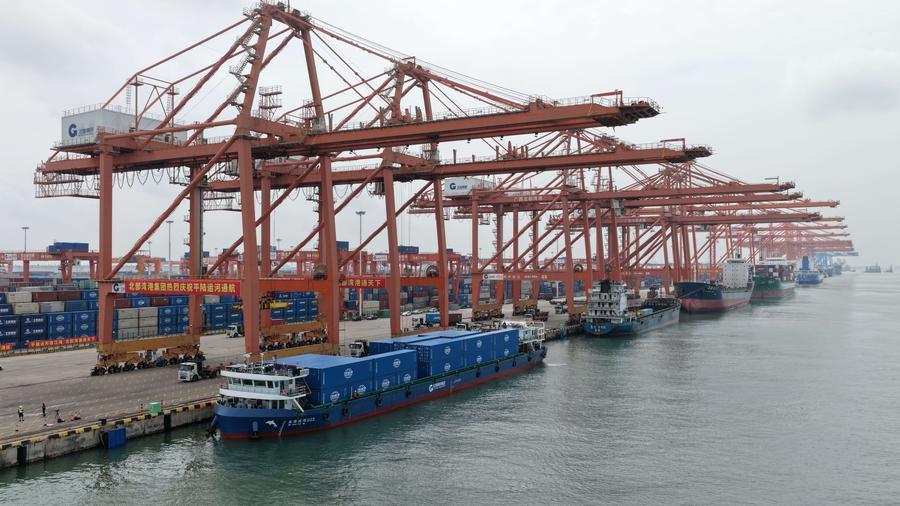
A drone photo taken on Sept. 16, 2026 shows the Qinzhou Port area of Beibu Gulf Port in Qinzhou, south China's Guangxi Zhuang Autonomous Region. (Xinhua/Zhang Ailin)
Designed for vessels of up to 5,000 tonnes, the canal shortens the inland waterway journey for goods from southwest China to the sea by more than 560 kilometers compared with traditional routes through ports in Guangdong Province. It is expected to reduce overall logistics costs by 18 to 30 percent and save more than 5 billion yuan in transportation costs each year.
Lu Xinning, vice chairperson of the regional government of Guangxi, said the canal creates a new link between China's market of 1.4 billion people and ASEAN's nearly 700 million consumers. Its impact, Lu said, could extend beyond the movement of goods, spurring new cross-border investment and deepening regional supply-chain integration.
The canal took over four years to build. Most of it was created by widening, deepening and straightening existing waterways, while a small section had to be excavated through dry land and mountainous terrain.
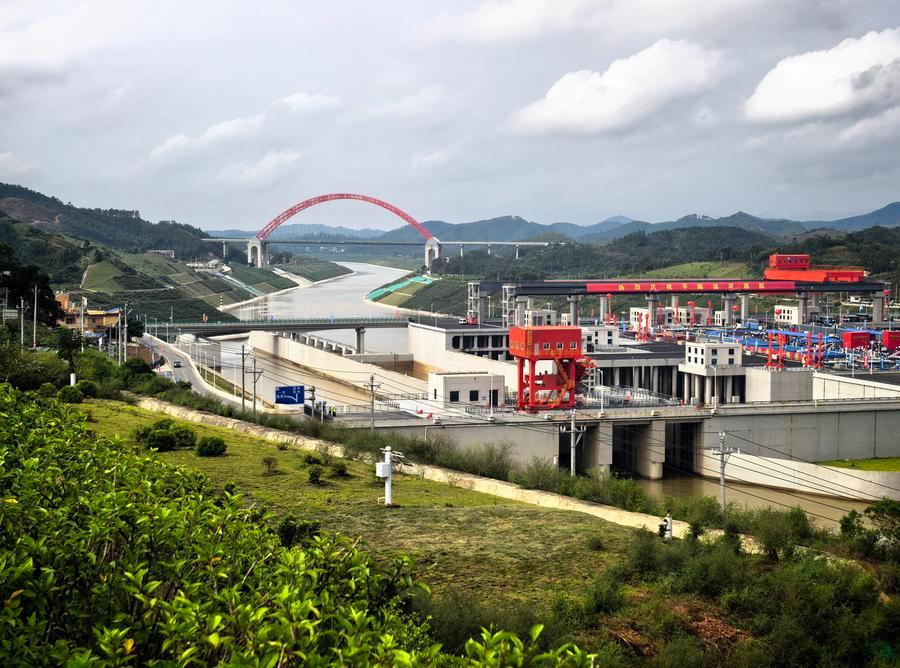
This photo taken on Sept. 16, 2026 shows the Madao Hub on the Pinglu Canal in south China's Guangxi Zhuang Autonomous Region. (Xinhua/Liu Weibing)
"There was no established model or ready-made precedent to follow," said Cheng Yaofei, chairman of Guangxi Pinglu Canal Construction Co., Ltd.
One of the biggest engineering challenges was a 65-meter difference in water level, roughly the height of a 20-plus-story building. Three navigation hubs, all featuring twin-line ship locks, were built to raise and lower vessels along the canal.
Engineers developed water-recycling systems at the hubs, enabling the canal to save more than 1 billion cubic meters of water annually.
Environmental protection was another priority during construction. More than 98 percent of the roughly 315 million cubic meters of earth and rock excavated during construction was reused. The canal also includes a fish passage more than 480 meters long and a dedicated wildlife crossing for land animals including leopard cats and squirrels.
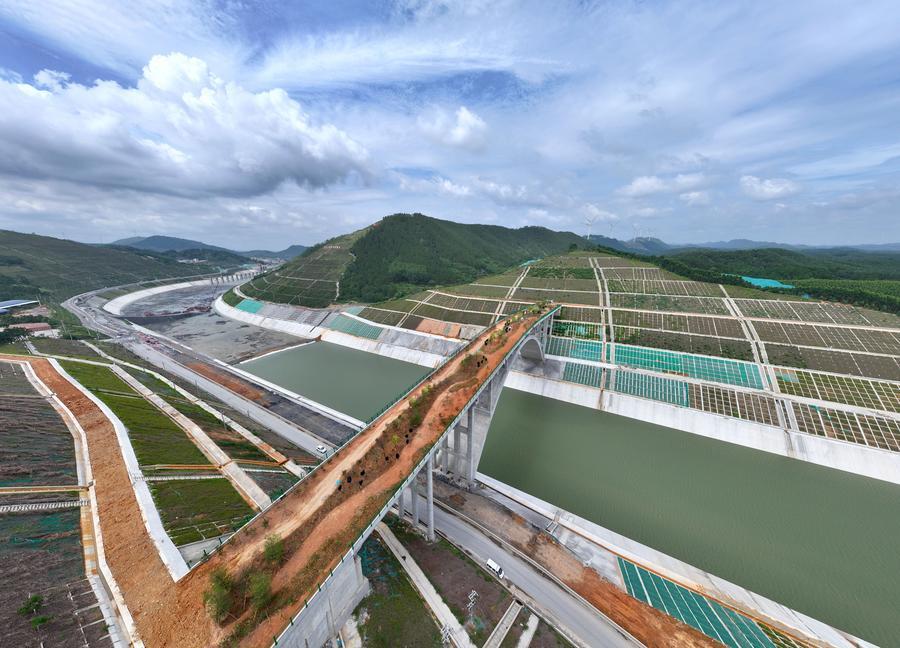
A drone photo taken on June 8, 2026 shows a view of the dedicated wildlife corridor bridge of the Pinglu Canal in Jiuzhou Town, Lingshan County of Qinzhou City in south China's Guangxi Zhuang Autonomous Region. (Xinhua/Zhou Hua)
The canal opens in the first year of China's 15th Five-Year Plan period (2026-2030), as the world's second-largest economy seeks to promote more coordinated regional development and further expand high-standard opening up -- priorities outlined in the plan.
The new artery carries particular significance for China's southwest, which has long lagged behind the more prosperous eastern coast and faced higher costs getting goods to seaports. Coal, ore, grain, new-energy materials and auto parts from the region can now take a more direct route to overseas markets.
In the near term, the canal is likely to reshape existing cargo flows, with some freight shifting from road and rail to waterways and from the Pearl River Estuary to the Beibu Gulf, said Meng Shuang, an associate professor at Central University of Finance and Economics.
Over time, Meng said, the lower cost of reaching the sea could generate new trade, draw investment inland and reshape industrial development along the canal.
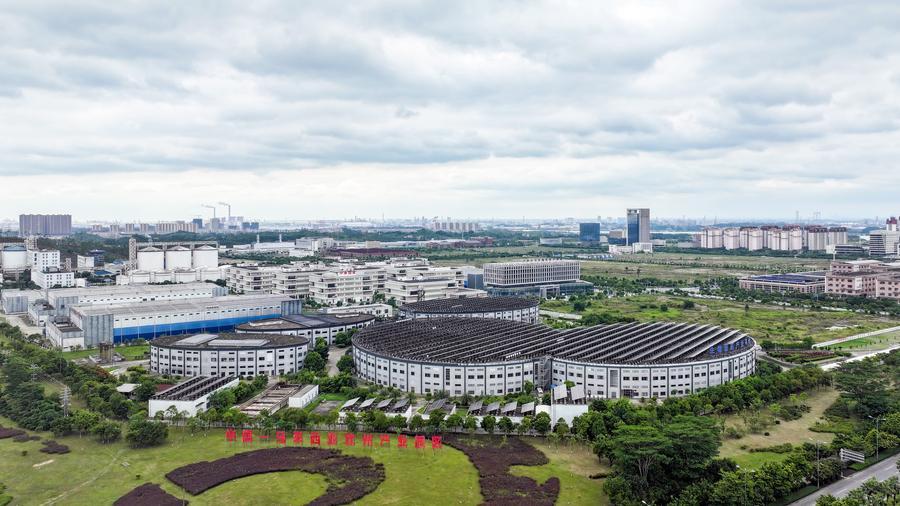
An aerial drone photo taken on Sept. 4, 2026 shows a view of the China-Malaysia Qinzhou Industrial Park in Qinzhou, south China's Guangxi Zhuang Autonomous Region. (Xinhua/Cao Yiming)
With China and ASEAN seeking closer economic ties and greater regional connectivity, experts say the Pinglu Canal could provide a new corridor for goods to flow in both directions between the vast Chinese and ASEAN markets.
China's trade with ASEAN exceeded 1 trillion U.S. dollars for the first time last year. In the first seven months of 2026, total trade between the two sides reached 744.41 billion U.S. dollars, an increase of 24.7 percent year on year, accounting for 21.8 percent of China's total foreign trade during this period.
BeBe Zhao, president of Singapore-China Integrated Developments (Guangxi) Pte. Ltd., said the canal could bring new opportunities for businesses on both sides. ASEAN products could move more efficiently into western China, while goods manufactured there could reach global markets through regional hubs such as Singapore.
"The new route will not only make trade more efficient but also strengthen Singapore's role as a regional transshipment and trade hub," Zhao said.
For Boonsub Panichakarn from the Faculty of Logistics and Digital Supply Chain at Naresuan University in Thailand, the canal's significance goes beyond the distance it saves.
It lies in how much the canal can reduce logistics costs, time variability and uncertainty across the entire ASEAN-southwest China supply chain, he said.

Tel:86-10-65363107, 86-10-65368220, 86-10-65363106
 Scan the QR Code
 Follow Us