





- BRNN
- BRI News
- BRNN News
- Database
Official Documents Polices and Regulations
Inter-government Documents International Cooperation BRI Countries
Business Guide Economic Data BRI Data
Trade
Investment Projects Latest projects
Cases - Content Pool
The Pinglu Canal, China's first major river-to-sea canal project that has been planned and coordinated at the national level since 1949, is set to open for navigation on Sept. 16, 2026.
What changes will this landmark project bring to the region? A closer look at the project from three dimensions -- economy, livelihoods, and environment -- offers a clear picture.
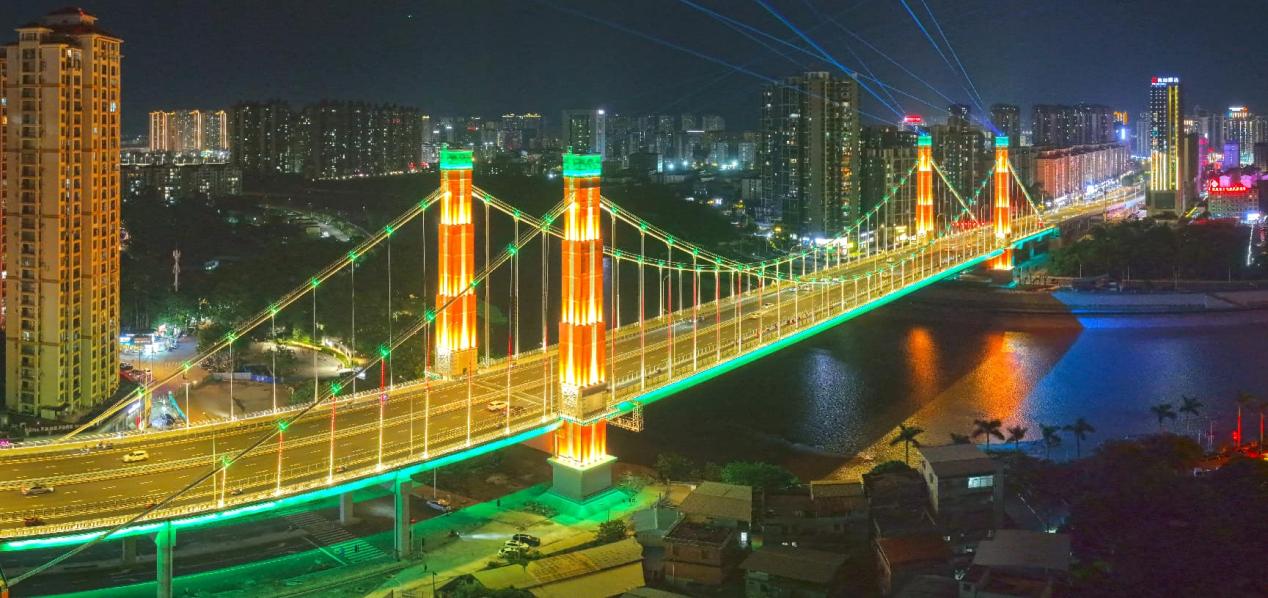
Photo shows the Zicai Bridge over the Pinglu Canal. (Photo/He Guangmin)
Economic benefits: injecting new vitality into regional development
Once operational, cargo vessels will enter the canal at the mouth of the Pingtang River after passing Hengzhou in south China's Guangxi Zhuang autonomous region, then sail south to Qinzhou Port and out to sea. This will provide southwestern China with a more direct water route linking its inland regions to the ocean.
The reduction in distance is significant. Goods shipped from southwestern China via the Pinglu Canal will travel approximately 560 kilometers less along inland waterways to the sea than those shipped via Guangzhou Port in Guangdong province.
"Logistics costs are expected to fall by 18 to 30 percent, saving around 5.2 billion yuan ($774 million) in social transportation costs each year," said Cheng Yaofei, commander of the Pinglu Canal project construction headquarters.
For an individual company, that means lower transportation costs. For an entire region, it creates opportunities for industrial relocation and reorganization.
In 2025, the Pinglu Canal Guigang Economic Development Zone signed contracts for ten new projects with a combined investment of approximately 13.3 billion yuan. In Qinzhou, Shanghai Huayi, a Chinese chemical enterprise group, is developing an integrated chemical and new materials industrial base with a planned total investment of around 100 billion yuan. The company intends to use the canal to expand its markets and connect upstream and downstream businesses. Guangxi Jingui Pulp & Paper Co., Ltd. is also planning to build a terminal along the canal so that raw materials such as timber and calcite can be transported directly to its factories by water.
Lower logistics costs are boosting the region's appeal for industrial clustering and creating new momentum for development. At the Liujing Port Area of Nanning Port in Nanning, capital of Guangxi, berths have been upgraded from handling 2,000-ton vessels to 5,000-ton vessels. Eleven river-sea intermodal berths at Qinzhou Port have also been upgraded. Cross-border transport routes, including the China-Laos Railway, are expected to connect with the inland waterway network as well.
Wu Jian, director of the Institute of Regional Development at the Guangxi Academy of Social Sciences, noted that lower transportation costs are expected to attract industries, logistics, and producer services to cluster along the canal, while further strengthening industrial links between Guangxi and the Guangdong-Hong Kong-Macao Greater Bay Area, and ASEAN.
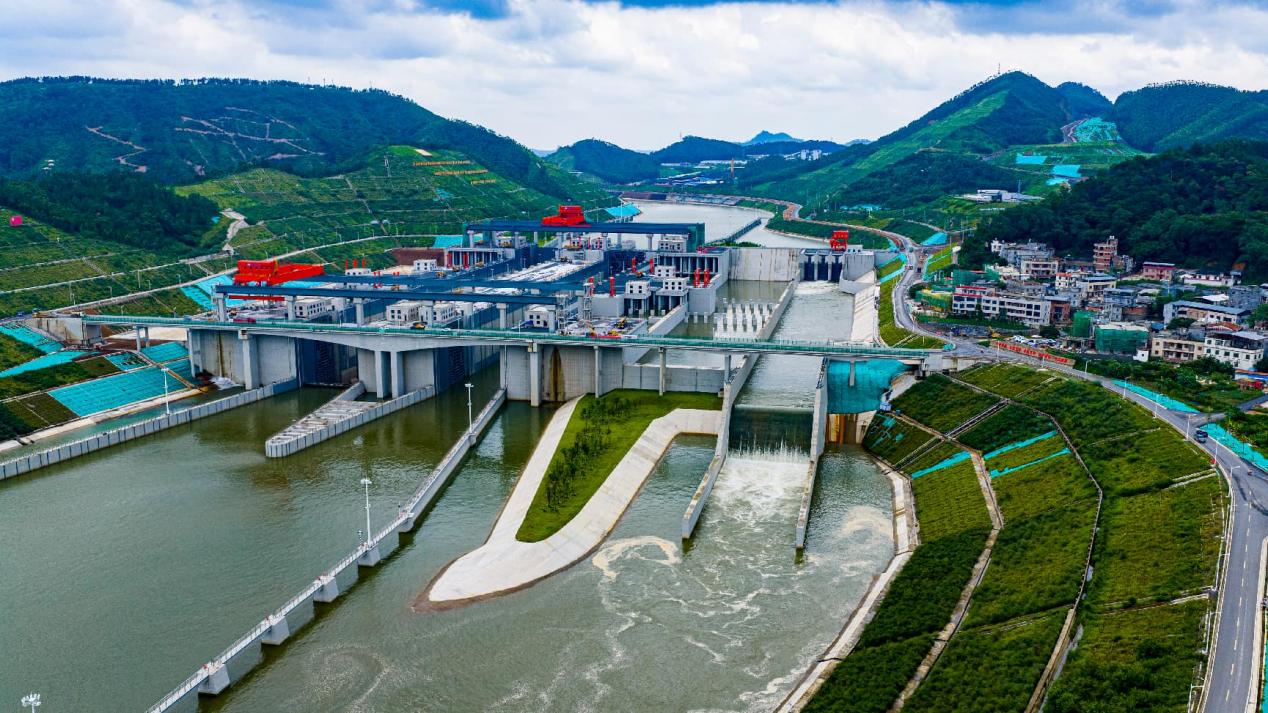
Photo shows the Madao water control hub of the Pinglu Canal. (Photo/Ji Haixin)
Benefits for people -- enabling residents along the river to live and work in greater comfort
The Pinglu Canal is not only changing the flow of goods; it is reshaping the lives of people living along its route.
At a resettlement site in Shaping township, Lingshan county, Qinzhou, rows of neat townhouses stand alongside well-equipped public facilities, including a recreational square, a farmers' market, a kindergarten and a supermarket.
A total of 13 centralized resettlement sites have been planned and built across Luwu, Jiuzhou, and Shaping townships in Lingshan county. So far, 1,498 households, representing 6,156 people, have been relocated, and all resettlement homes have been handed over to the residents.
Chen Jidong, a relocated resident at the Shaping site, is very pleased with his new home.
"In the past, the market and school were scattered around the village and quite far away. Now everything is within a few minutes' reach, making everyday life much more convenient," Chen said.
His family has not only moved into a new home but also bought a truck. Chen previously made a living transporting materials at the Pinglu Canal construction site.
"With the canal opening, there will be greater demand for transportation, so we have more to look forward to," he said.
More local job opportunities close to home are reaching a growing number of residents. Thirty-four-year-old Huang Zhenjie has worked with the "Pinglu Employment" service program for over three years. He once helped a returned migrant worker secure a position as a steel bar worker at a canal construction site. After mastering the necessary skills, the worker now earns 12,000 yuan per month.
"We not only recommend jobs, but also organize trial work and training," Huang said.
So far, construction of the Pinglu Canal has created more than 70,000 job opportunities for local residents, with more than 2.6 billion yuan in labor remuneration.
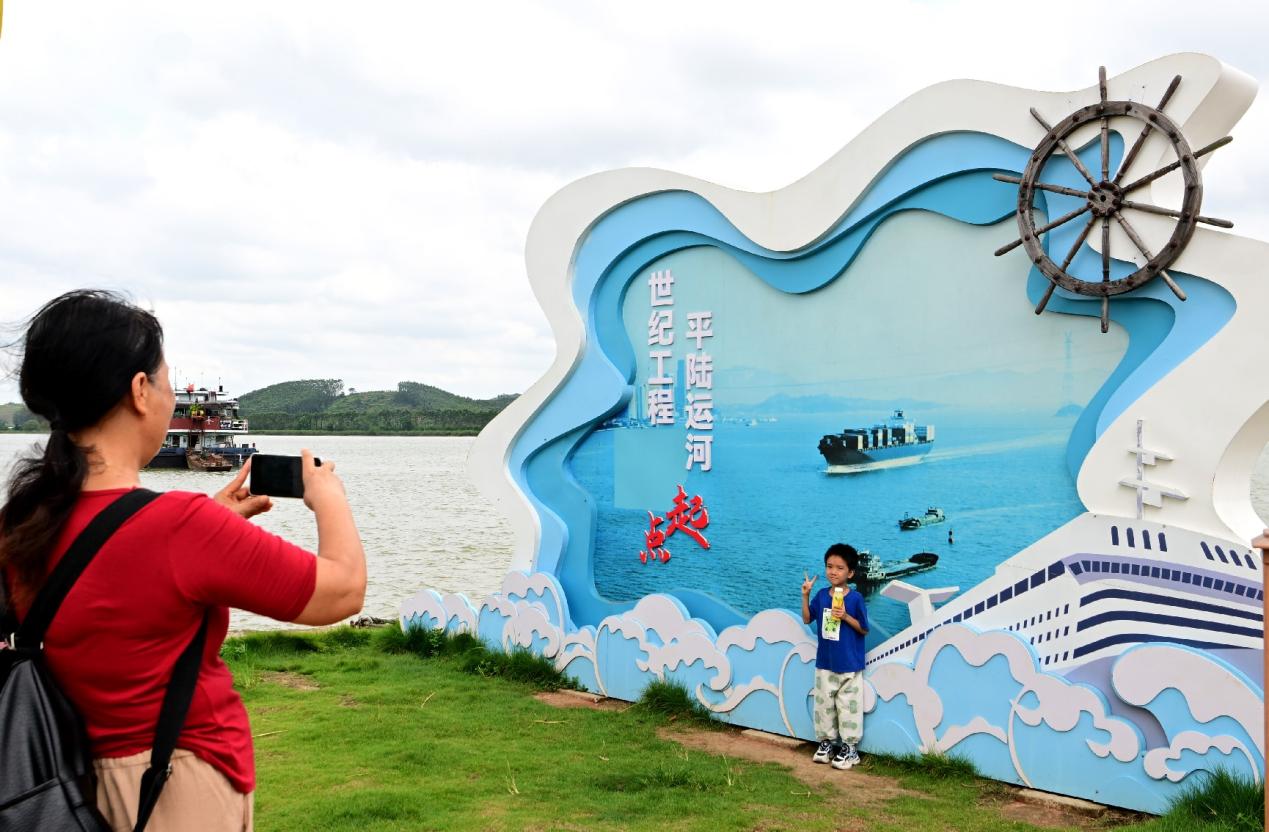
A child poses for a picture at the starting point of the Pinglu Canal in Pingtang village, Xinfu township, Hengzhou, south China's Guangxi Zhuang autonomous region. (Photo/Ji Haixin)
Environmental benefits: protecting lucid waters and lush mountains through meticulous measures
As the canal advances, environmental protection has kept pace every step of the way.
Near the Qingnian water control hub, a 480-meter-long composite fish passage and a smart monitoring and assessment system have been put into operation. The Qingnian water gate, built in 1959, once obstructed fish migration. Today, a vertical-slot fishway and an eel passage have reconnected the waters upstream and downstream.
Since the system began operating in 2025, its sonar monitoring system has recorded more than 76,000 fish swimming upstream and more than 115,000 swimming downstream, with over 10 species successfully completing their migration.
Fish now have a passage for migration, and terrestrial animals have safe routes to cross the canal as well. Near the Madao water control hub, a 240-meter-long, 20-meter-wide wildlife overpass spans the canal. The bridge is covered with soil and planted with native vegetation, with rocks and water-collection points added to create a habitat that allows wildlife to cross in surroundings as familiar as possible.
Mangroves, too, have found a "new home." According to project officials, 19.8 kilometers of disturbed areas outside the project boundary are being protected in situ. For mangroves within the project boundary that could not be preserved, 9,572 trees were transplanted to nearby locations, while 275,000 trees were restored elsewhere across an area three times the original size, covering 32.3 hectares. During construction, 966 hectares of mangroves were cleaned and 156 hectares treated for pests and diseases.
Today, the number of bird species in the mangrove reserve has risen from 28 to 34, and an ecological corridor is largely in place.
From a shorter shipping route to the clustering of industries, from new homes to improved livelihoods, and from a restored fish passage to the renewal of mangrove forests, these three dimensions together show the Pinglu Canal's broader benefits.
The canal connects rivers with the sea, but more importantly, it connects development, people's livelihoods and ecological conservation.

Tel:86-10-65363107, 86-10-65368220, 86-10-65363106
 Scan the QR Code
 Follow Us