Chinese shoppers buying from abroad more than ever
On her way home from work, Wang Nan, a 1980s-born Beijing new media professional, clicked a link a colleague had shared: Monthong durians from Thailand, cheap and delivered free. She placed an order, and three days later a hefty spiky durian turned up at her apartment.
Recently, the General Administration of Customs of China released data showing that cross-border e-commerce exports through overseas warehouses grew 3.3-fold year on year in the first half of this year, and that 140 million people nationwide bought goods from overseas through cross-border e-commerce.
According to customs statistics, China's imports totaled 10.74 trillion yuan (about $1.6 trillion) in the first half of this year, up 22.1 percent year on year. Import growth outpaced export growth by 8.7 percentage points and contributed more to overall foreign trade growth than exports.
Alibaba's cross-border platform Tmall Global now carries more than 40,000 overseas brands from over 110 countries and regions — beauty, baby and maternity, apparel, food, pet supplies and consumer electronics among them.
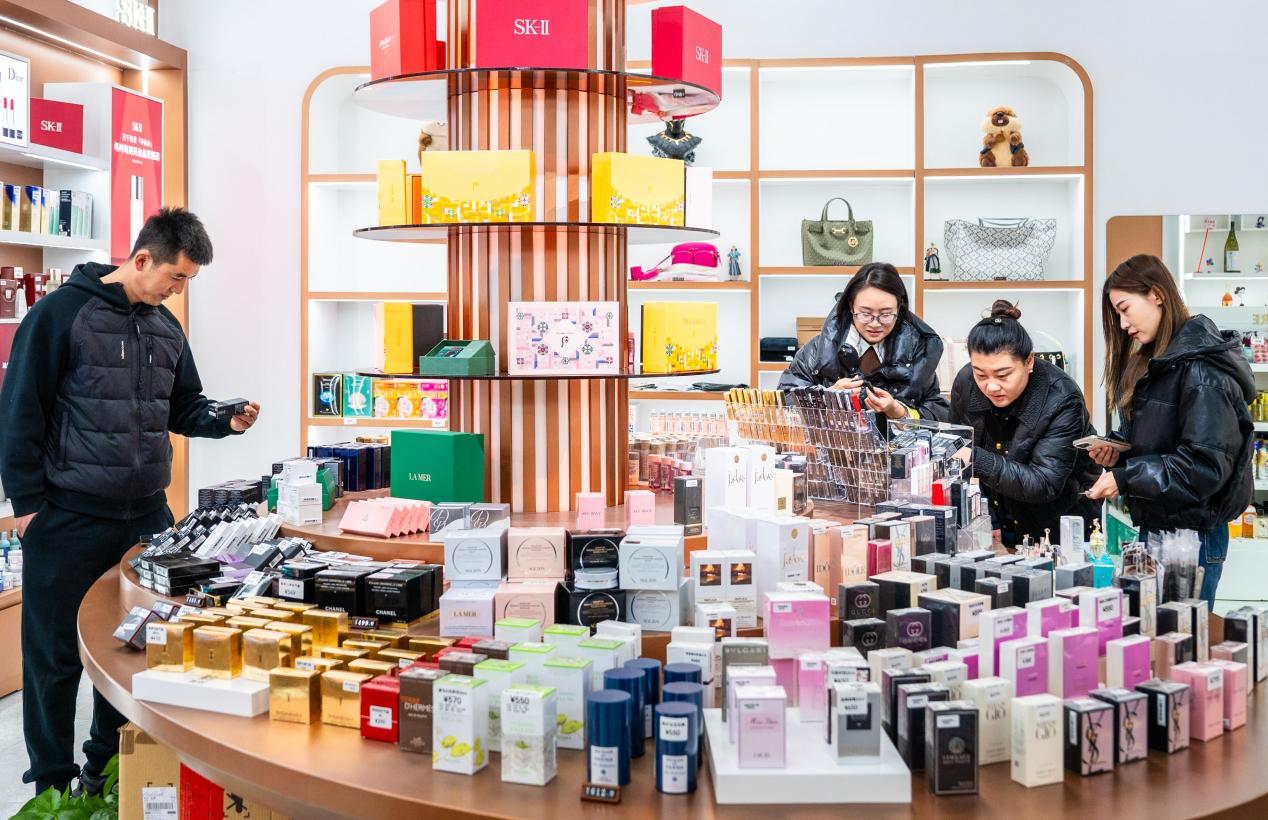
Consumers buy cross-border commodities at a store in Hohhot Comprehensive Bonded Zone, north China's Inner Mongolia autonomous region. (Photo/Ding Genhou)
After years of development, JD Worldwide, the cross-border e-commerce platform of Chinese e-commerce giant JD.com, now hosts more than 20,000 overseas brands from over 100 countries and regions.
Zhang Yiting, an associate research fellow at the Chinese Academy of Macroeconomic Research, said many overseas brands now enter China through distributors or their own operations. Both routes, she said, reflect a belief in the market's long-term value. Brands are also increasingly willing to reorganize their China business to gain more control over it.
Overseas brands are not merely entering China — they are becoming part of everyday shopping.
Last Black Friday, retailers from more than 30 countries and regions went live on cross-border e-commerce platforms. From their homes, Chinese shoppers bought from more than 130 brands at Citadel Outlets in Los Angeles at 60 to 70 percent off.
According to a 2026 report by iiMedia Research, 41.96 percent of Chinese consumers made cross-border e-commerce purchases once or twice a quarter over the past three years, and 39.78 percent shopped one to three times a month.
Wang has seen the change up close: what used to be an occasional splurge is now an everyday purchase.
Ten years ago, finding overseas-exclusive sneaker colorways or niche imported skincare meant going through daigou — personal shoppers who buy abroad and resell in China. With no mature cross-border platforms, she hunted through group chats or asked friends traveling overseas to bring things back. Authenticity was never certain, and every hand the goods passed through added to the price.
Logistics was the biggest headache. Orders often took one or two months to arrive, and delays were common.
Today, Wang opens an app and products from around the world are a few taps away. A mature cross-border logistics network has made three-day delivery of overseas goods routine, with next-day service increasingly common.
According to Zhang, the significance of 140 million cross-border shoppers goes beyond the number itself. It points to a new direction in China's consumer market. She said that digital technology has broken down barriers of distance and distribution, letting ordinary consumers reach global markets directly — and extending globalization from production to consumption.
According to data from business information platform Tianyancha, China now has more than 51,000 cross-border e-commerce-related companies that are active or in operation.
The booming cross-border e-commerce sector is also reshaping the traditional daigou business.
"I'm semi-retired now and only take orders from a few longtime customers, friends and relatives," said Sun Ni, who has lived in Sydney, Australia, for 16 years. She has witnessed the rise, boom and decline of daigou business in Australia.
The daigou trade took off in Australia around 2008, as Chinese demand surged for imported infant formula, health supplements and other goods. According to the Australian Broadcasting Corporation, some 150,000 people there were involved — professional buyers like Sun Ni, plus a much larger number of international students and tourists who bought occasionally. Between them they formed a supply chain that ran from individual buyers through major distributors and daigou stores to logistics providers.
Back then, Sun's suitcase was always packed with baby formula, shoes and health supplements. The products sold themselves.
"Today, almost every well-known infant formula brand in the world has entered the Chinese market through cross-border e-commerce. Consumers no longer need middlemen like me," Sun explained.
Experts say three changes have made global price comparisons routine: Information is easier to find, products pass through fewer hands on their way to the buyer, and more brands compete for the same customers.
At the 2025 China International Import Expo, foreign beauty companies showcased products developed specifically for Chinese consumers. These launched in China first, before reaching other global markets. China is no longer a market where products arrive late — it has become a place to launch them early.
Imported consumer goods are becoming more specialized. Demand has shifted from broad categories to specific pain points — and the brands filling them are arriving fast.
On Tmall Global in 2025, the strongest influx of new brands came in health, beauty and personal care, and mother-and-baby products. Within mother-and-baby, infant and children's food was the fastest-growing segment, with new brands up 128 percent

 Follow Us
 Scan the QR Code
