Young conservators restore Sanxingdui in SW China's Sichuan
At the Sanxingdui Museum in southwest China's Sichuan Province, conservator Xie Li and her colleagues put on full protective gear before entering a cold, humidity-controlled storage room. Inside are hundreds of elephant tusks unearthed from new sacrificial pits at the Sanxingdui Ruins site in 2021.
They carefully peel back the protective film from each tusk, replace the specialized moisture wipes and inspect the surfaces for signs of mold or decay. Samples are sent to a lab for further testing.
The museum has been restoring relics from the Sanxingdui Ruins site since it opened. Its conservation center, established in 2010, has grown from four or five people to more than 10 specialists, whose work ranges from analysis and research to data collection and restoration planning.
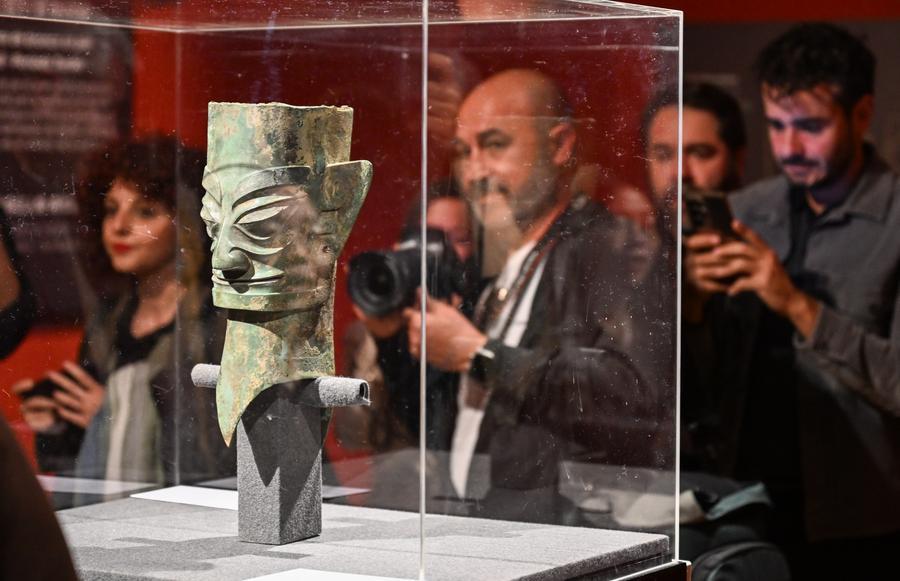
People view a bronze human head from the Sanxingdui archaeological site during an exhibition on the bronze civilization of southwest China at the Guadalajara Museum in Guadalajara, Spain, on March 17, 2026. (Xinhua/Cheng Min)
"Our team's average age is about 36," said Yu Jian, an associate researcher at the museum.
Beyond hands-on restoration, team members create detailed damage maps of the relics, precisely recording cracks, weathering, corrosion and other damage. These maps provide a solid data foundation for restoration and long-term preservation.
Xie, the team's first conservator born in the 1990s, specializes in bronze and ceramic restoration. She joined the museum in 2014 and spent seven years training before she began hands-on restoration of Sanxingdui artifacts in 2021, following the excavation of the new sacrificial pits.
"Restoration takes not just careful hands but the patience to sit still for hours," she said.
Chen Yanxi, born in the 2000s, brought a different background to the team: a chemistry degree from Sichuan Normal University. Since joining in 2025, she has used her training in X-ray imaging analysis to support restoration work.
"My hands were shaking the first time I cleaned a relic fragment. I was terrified of damaging it," Chen said. "Finishing it under my mentor's guidance gave me a sense of accomplishment I can't describe."
As of August 2026, the team had cleaned and restored more than 1,000 ivory, bronze, jade and gold artifacts unearthed in the 2021 excavation. It has also shared its restoration techniques and expertise with other institutions, helping fill gaps in China's broader cultural relic conservation efforts.

 Follow Us
 Scan the QR Code
