Maowusu Sandy Land turns green through decades of effort
"Over 20 years ago, an American named Ronald Sakolsky gave financial support to Yin Yuzhen, a Chinese desert control worker, for her tree-planting effort. Just recently, Ronald, now an elderly man, returned to China. He saw with his own eyes that the desert back then had turned into a lush forest," Chinese President Xi Jinping said, recounting their story in the Maowusu Sandy Land in Uxin banner, Ordos, north China's Inner Mongolia Autonomous Region, during his state visit to the U.S.
Before leaving the Maowusu sandy land, Sakolsky invited people around the world to visit Inner Mongolia and plant a tree with their own hands.
On Sept. 10, master craftsmen from various trades joined Yin to plant saplings at an ecological base named after her in Maowusu Sandy Land. Nearly 600 volunteers also took part in a public tree-planting campaign that day at the Engebei ecological demonstration site in Dalad banner, Ordos.
Sakolsky's return to visit Yin, 26 years after their first meeting, has drawn renewed attention to anti‑desertification efforts across Maowusu Sandy Land, as more people learn about the restoration work and recognize its significance.
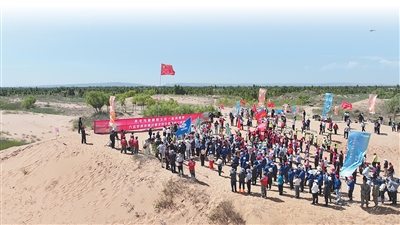
A public tree-planting campaign inviting people to plant trees with Yin Yuzhen attracts many participants. (Photo/Yu Jiemeng)
Today, 8.39 million mu (about 559,593 hectares) of the sandy land in Uxin banner has been brought under control. This represents a treatment rate of 85 percent, and forest coverage has risen to 32.92 percent.
In 1985, Yin married into Salawusu village in Uxin banner, deep within Maowusu Sandy Land, where drifting sand frequently buried houses. She vowed she would wear herself out planting trees rather than be tormented by the sand. Over four decades, she and her husband, Bai Wanxiang, have endured countless setbacks, replanting time and again saplings swallowed by shifting sand. They have now turned more than 70,000 mu of desert into an oasis.
Yin is one of many who have helped transform the landscape. In the 1950s, desertified and sandy lands made up more than 90 percent of Uxin banner, with forest coverage at only 2.6 percent. Baoriledai, a sand‑control pioneer, led more than 60 young people into the desert, helping stabilize over 100,000 mu of shifting dunes across more than 10 years. In 2001, 13 women herders from the banner set up a sand‑control team. Today, more than 240 local households run afforestation projects covering over 3,000 mu each.
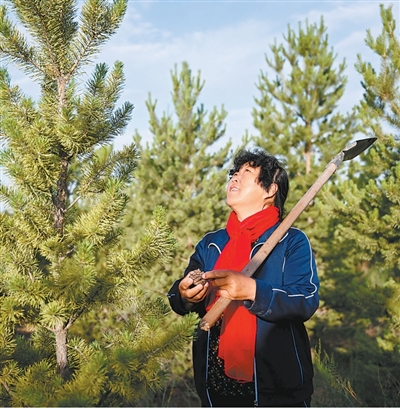
Yin Yuzhen checks the growth of trees while patrolling the forest in the Maowusu Sandy Land in Uxin banner, Ordos, north China's Inner Mongolia Autonomous Region. (Xinhua/Li Zhipeng)
Public participation keeps growing. A tree‑planting campaign launched by Yin on June 5 drew more than 1,000 volunteers from Inner Mongolia, Beijing, north China’s Shanxi Province and other regions. Over two days, they planted trees across 500 mu.
"Volunteers from across the country planting trees together is the best way to carry forward the spirit of sand control," Yin said.
Over the decades, volunteers from more than 20 countries and regions have joined forces to rehabilitate the sandy land. On Aug. 11, nearly 120 Chinese and international students attending an international summer school at China Agricultural University visited the site, where Yin demonstrated tree-planting techniques to the international participants.
Technology is also playing an increasingly important role. On the site, BeiDou-guided machinery can autonomously dig trenches, plant seedlings, backfill soil and compact the ground.
Tiemuer Bagena, head of the forestry and grassland workstation in Galutu town, Uxin banner, said trial data show planting spacing can be controlled to within 5 centimeters, and the machine boasts more than three times the efficiency of manual planting.
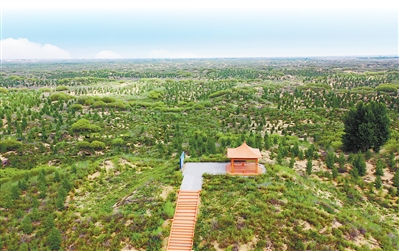
A view of a sand control station in the Maowusu Sandy Land in Uxin banner, Ordos, north China's Inner Mongolia Autonomous Region. (Photo courtesy of the Publicity Department of the Communist Party of China Uxin Banner Committee)
After graduating from university in 2003, he returned to his hometown and has worked on the front lines of desertification control for 23 years.
His team has developed over 10 types of machines, which are now in use by more than 200 households, afforestation operators and companies across locations including Ordos and Yulin city in northwest China’s Shaanxi Province.
In 2023, Uxin banner established a doctoral workstation to gather experts from universities and research institutions as well as local veterans of desert control. New technologies and equipment, including tree-planting robots and integrated space-air-ground monitoring systems, are gradually phasing out the labor-intensive practice of mobilizing large workforces.
These efforts are also generating economic returns. When Sakolsky visited Yin's home, he learned that Yin's annual income was 1 million yuan (about $149,202.5). "Amazing," he said repeatedly.
In 2005, Yin set up a 500-mu oasis eco-park where corn, watermelons and cherries are grown. She later planted 30 mu of desert roses, processing them into rose tea, rose cakes, rose jam and other sought-after specialty products. In recent years, Yin founded a company that has expanded its business from selling fresh farm produce to providing fruit-picking experiences, tourism and study tours.
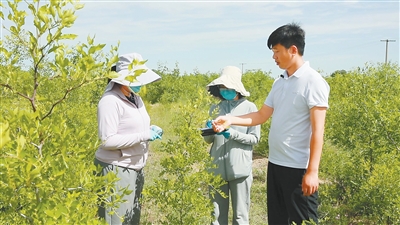
Li Kong (1st R) and students from Inner Mongolia Agricultural University collect samples in the Maowusu Sandy Land in Uxin banner, Ordos, north China's Inner Mongolia Autonomous Region. (Photo/Wang Qi)
Li Kong, a resident of Anyang in central China’s Henan Province, came to the sandy land with his father in 2014 to grow jujubes. After years of experimentation, they developed three high-quality varieties boasting survival rates above 90 percent and yields of more than 1,000 kilograms per mu.
The pair also regularly runs training sessions for growers, drawing more than 500 participants to date. Their technical team prunes local growers’ jujube trees free of charge and shares yield-boosting techniques. The venture has created jobs for over 100 local residents, whose average annual income has increased by 20,000 yuan.
In a village in Tuke town, Uxin banner, a factory processes branches of Salix psammophila shrubs into eco-friendly biomass fuel pellets. The shrubs need pruning every three to five years to remain healthy. Villagers sell the branches to the factory at 160 to 180 yuan per tonne, earning households an extra 5,000 to 8,000 yuan each year in the off-season, said Liu Erfei, the village’s Party chief.
The banner’s forest and desert industries now produce an annual output value of over 4.1 billion yuan. Its products span specialty crops including morel mushrooms, astragalus roots, licorice and sea buckthorn, alongside other goods made from local ecological resources.

 Follow Us
 Scan the QR Code
