China issues first policy document dedicated to technology-driven commerce
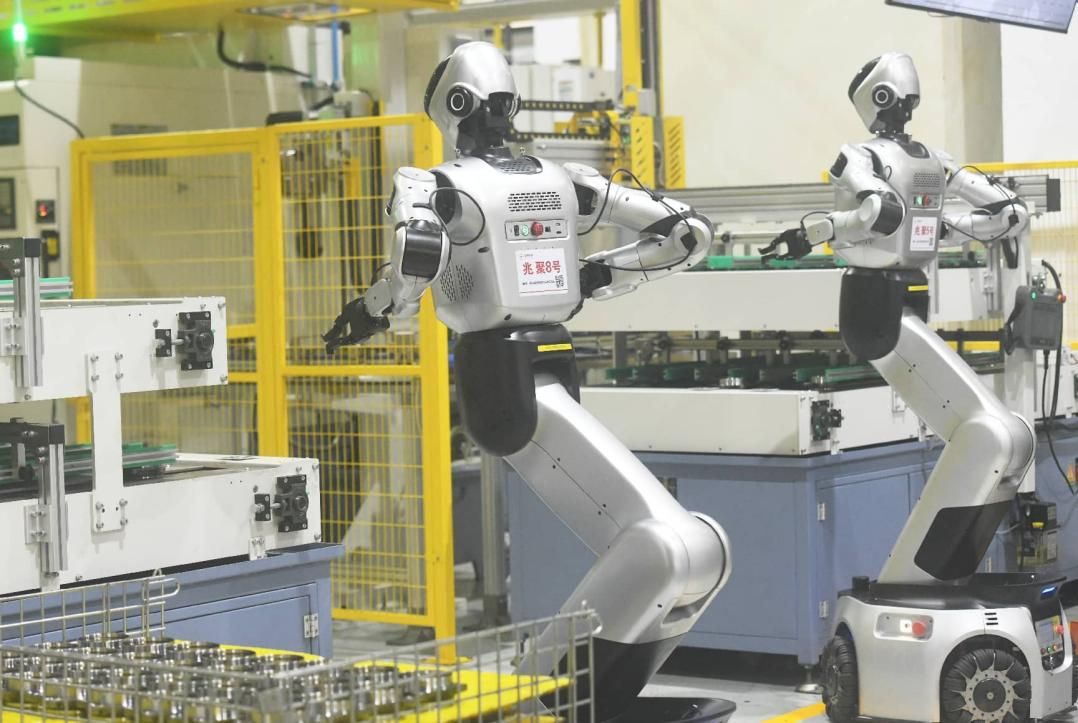
Humanoid robots handle production materials in a workshop of a mechanical and electrical company in Hangzhou, east China's Zhejiang province. (Photo/Long Wei)
A new round of scientific and technological revolution and industrial transformation is gathering pace. Emerging technologies such as artificial intelligence (AI), big data, embodied intelligence and digital twins are evolving rapidly, reshaping how commerce is organized and operated while improving the consumer experience.
By harnessing technology, businesses can expand the supply of goods and services, create more diverse consumption scenarios and reduce the cost of consumer decision-making, while making distribution and circulation more efficient and lowering logistics costs. These advances can help bring supply and demand into dynamic balance at a higher level.
China recently released new guidelines on accelerating technology-driven commerce, its first policy document dedicated to this subject. Yuan Xiaoming, assistant minister of commerce, said the comprehensive and systematic guidelines were formulated in light of the requirements of China's new stage of development. They place technological innovation at the heart of the entire commerce chain and seek to promote deeper integration between technology and commerce. Their key features can be summed up in three words: new, comprehensive and practical.
"New" means putting technological innovation at the forefront and responding to emerging consumption trends and changing consumer preferences.
As living standards rise, consumers are paying greater attention to product quality and the overall consumption experience. Data from the Ministry of Commerce showed that sales of smart glasses on major platforms rose 110 percent year on year in the first nine months of this year. The widespread application of AI, the Internet of Things and blockchain in the consumer sector has made technological innovation an increasingly important driver of consumption growth and upgrading.

A consumer browses new-model smartphones at a shopping mall in Leshan, southwest China's Sichuan province. (Photo/Li Huashi)
The guidelines respond to the latest developments in science and technology and industrial transformation. They address the immediate need to expand consumption and invigorate the consumer market, while looking to the longer term by using technological innovation to upgrade traditional commerce and foster emerging business models, injecting sustained momentum into high-quality commercial development.
"Comprehensive" means pursuing progress on both the supply and demand sides and covering the entire commerce chain and all business formats.
Vertically, the guidelines integrate technological innovation into every stage of commerce, from product research and development, manufacturing and service provision on the supply side to wholesale, logistics, e-commerce and the final consumption experience.
Horizontally, they promote the technological upgrading of traditional businesses such as retail, catering and housekeeping to revitalize traditional consumption, while fostering new business models and formats, including commercial AI agents and green, circular consumption, to unlock the potential of emerging forms of consumption.
Together, these measures establish a comprehensive policy framework that coordinates supply and demand and promotes both traditional and new forms of consumption.
"Practical" means focusing on real-world problems and ensuring that policies can be implemented and their results assessed.
The guidelines target pressing issues in commerce with tailored measures. To better match the supply of goods with consumer demand, for example, they call for developing flexible manufacturing, promoting on-demand production and fostering a number of influential customized brands. To expand the supply of high-quality services, they propose accelerating the digital and intelligent transformation of services related to housekeeping, healthcare, elderly care and childcare, while developing upgraded services such as smart education, smart cultural tourism and smart sports.
To drive the upgrading of goods supply, China will further implement its special initiative on "AI + Manufacturing." Estimates show that the scale of China's core AI industry exceeded 1.2 trillion yuan ($179.69 billion) in 2025.
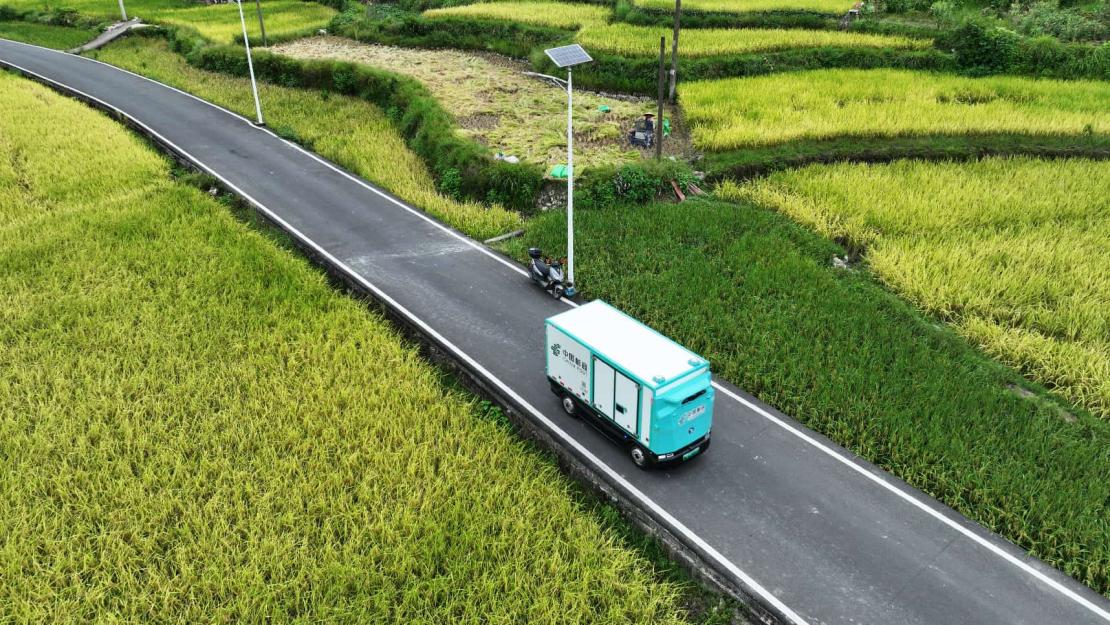
An unmanned delivery vehicle runs on a rural road in Jinping county, southwest China's Guizhou province. (Photo/Yang Xiaohai)
Intelligent products and services are now becoming increasingly widespread: AI-powered smartphones are finding their way into people's pockets, intelligent connected vehicles are taking to the roads, and humanoid robots are moving into factories. In the first half of this year, shipments of various smart terminals exceeded 100 million units.
In the first half of the year, the number of humanoid robot models in China exceeded 400, while output surpassed 40,000 units.
To expand the supply of upgraded services, China will launch pilot applications of AI in culture and tourism.
Zhou Hanping, an official with the Department of Industrial Development at the Ministry of Culture and Tourism, said that a number of museums, cultural venues and tourist attractions are leveraging technologies such as digital twins, extended reality and ultra-high-definition imaging to bring cultural resources to life.
In this way, artifacts long kept out of public view and the stories of history are being transformed into cultural and tourism experiences that visitors can see, participate in and connect with emotionally.
The Ministry of Culture and Tourism has selected and approved 14 projects for the pilot applications. These projects will help build experience and pave the way for successful practices to be rolled out nationwide.
Advancing technology-driven commerce requires the participation of businesses and organizations across the entire sector. It is a collective endeavor in which large enterprises build platforms, develop key technologies and set examples, while small and medium-sized enterprises adopt digital tools, access services and explore new markets.
By playing to their respective strengths and finding their place in the broader ecosystem, businesses of all sizes can share the benefits of technology-driven commerce.
Yuan said the Ministry of Commerce would work with other government departments to ensure that the guidelines are effectively implemented and that the potential of technological innovation is translated into tangible momentum for commercial development.

 Follow Us
 Scan the QR Code
