Online AI marketplace goes live in SW China's Sichuan
Thanks to an online artificial intelligence (AI) marketplace in southwest China's Sichuan Province, businesses can now shop for AI resources much like consumers browse e-commerce platforms, comparing products and prices before buying.
Located on Chengdu Sci-Tech Ecological Island in Tianfu New Area, Chengdu, capital of southwest China's Sichuan Province, the AI marketplace began operations on Oct. 22.
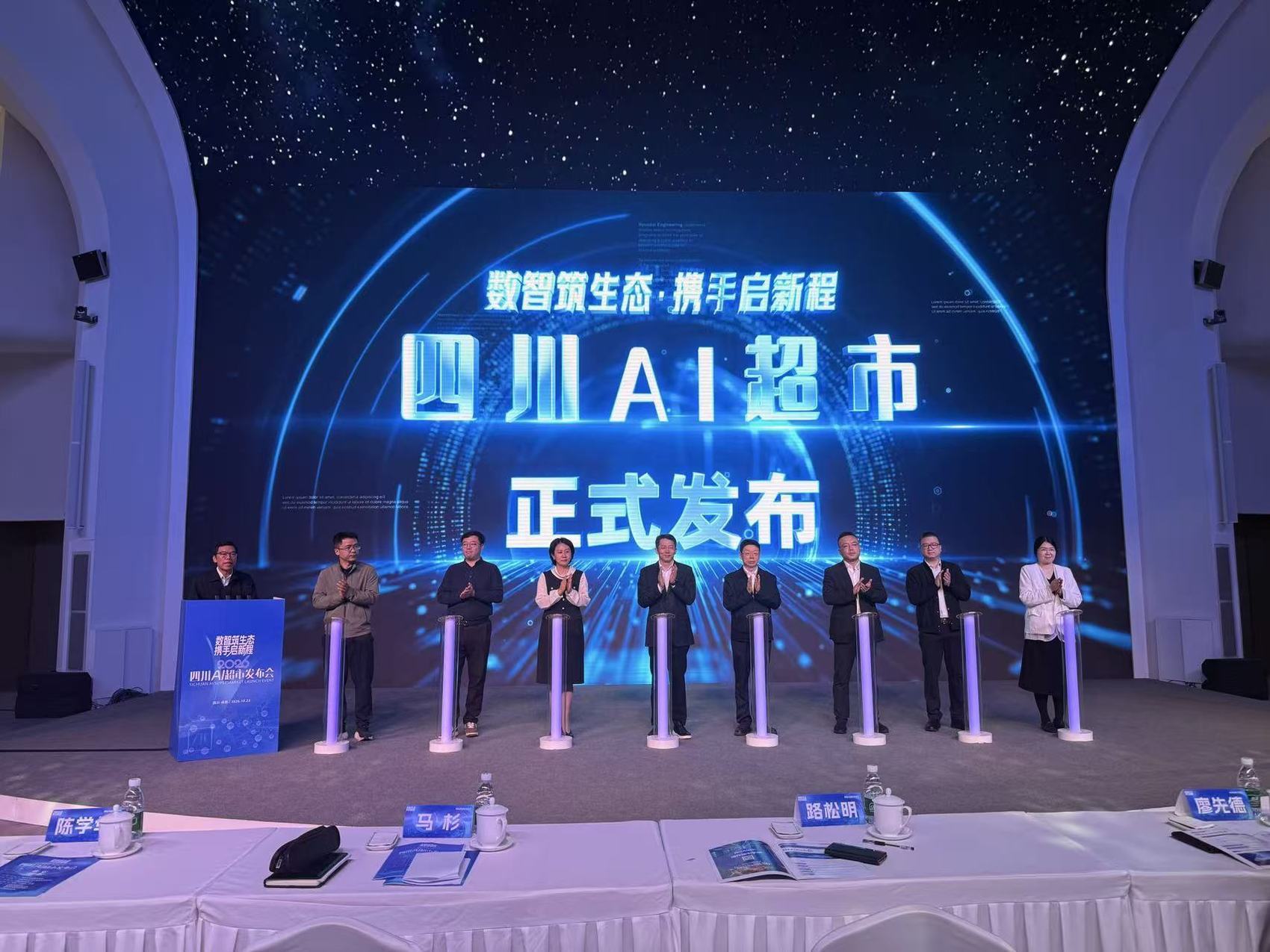
Photo shows the launch ceremony for the AI marketplace. (Photo/Sichuan Daily)
The platform brings together computing power, AI tokens, data, AI agents and end-user devices, giving businesses one place to access AI products and services.
The marketplace offers access to 118.8 EFLOPS of heterogeneous computing power from across China, 70.8 EFLOPS of which is its own.
It also hosts more than 170 large models, more than 40 industry-specific models and more than 60 AI agents, alongside datasets, end-user devices and more than 200 services spanning manufacturing, health care, government services and energy.
It builds on two China Telecom platforms — Xirang, for interconnecting and scheduling computing power, and Xingchen TokenHub — to pool computing resources and AI models from different locations and dispatch them from one place.
An AI shopping assistant can match a user's requirements with potential solutions in as little as 3 seconds, according to Ma Xing, deputy general manager of the AI data center at China Telecom's Sichuan subsidiary.
For businesses with specific needs, a team of more than 500 engineers provides in-person consultation, deployment and maintenance, Ma said.
The platform also offers flexible purchasing options. Instead of committing to monthly or annual computing power packages, businesses can buy compute credits or pay by the hour, lowering the cost of testing new AI applications. Buyers can also see where resources come from, check vendor information and compare prices.
The marketplace serves both suppliers and buyers. A token factory in Ya'an, Sichuan, for example, supplies computing power through the platform, letting customers buy capacity without building their own facilities.
Chengdu Sobey Digital Technology Co., Ltd., a Chengdu-based technology company, uses the marketplace to source data and AI agents.
"Previously, creating video content involved building models from scratch. Now, we can simply choose suitable AI video generation tools from the platform's offerings and start using them right away," said an executive of the company.
For Chengdu Minto Technology Co., Ltd., an AI agent provider, the platform offers opportunities on both the supply and demand side
"We spend more than 100 million yuan ($14.97 million) on computing power every year. In the past, we mainly relied on leasing and self-built infrastructure. With this platform in place, we are going to purchase around one-third of our computing power here and benefit from bulk-purchasing discounts, reducing our research and development costs," said Zhou Bo, deputy general manager of the company. "We also sell AI agents on the platform."
Despite the growing availability of AI tools, many businesses face three major obstacles to adoption: hard-to-use solutions, high costs and security concerns, an official from the Science and Technology Department of Sichuan Province said at the launch event for the AI marketplace.
Small and medium-sized enterprises (SMEs) may need two or three employees and one to two months to get an AI application running, the official said, noting that building their own computing infrastructure can also leave capacity idle during off-peak periods.
The official added that businesses may be reluctant to process sensitive financial or customer data using external computing services.
Sichuan's AI marketplace aims to address these challenges through centralized resource allocation and security safeguards.
Workloads can be routed to wherever the power is greenest — or to spare capacity in the middle of the night. The system supports 16 scheduling strategies in all.
According to credible sources, these measures can reduce computing latency by about 20 percent and overall costs by around 40 percent.
To address data-security concerns, the platform has set up an isolated trusted zone that uses physical separation, network whitelisting and a self-developed technology stack to keep core data within its bounds.
The marketplace is currently focused on SMEs and application scenarios including scientific research, cultural and creative industries, and industrial manufacturing.
Compared with AI platforms and marketplaces launched earlier elsewhere in China, Sichuan's stands out for the breadth of its resources, according to company representatives.
More than 200 suppliers have joined the platform, including China Telecom's AI subsidiary, Sichuan Daily Press Group, Tianfu Jiangxi Laboratory, and Sichuan Huakun Zhenyu Intelligent Technology Co., Ltd.

 Follow Us
 Scan the QR Code
