African coffee gains ground in Chinese market
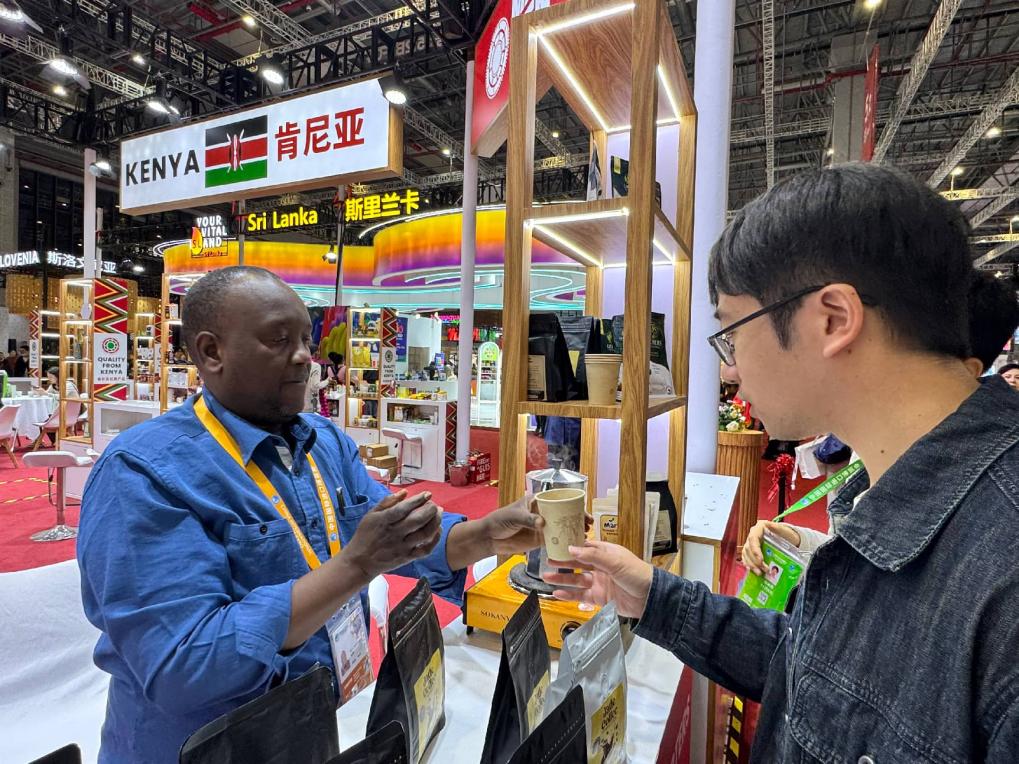
A Kenyan exhibitor introduces Kenyan coffee to a visitor at the ninth China International Import Expo (CIIE) in Shanghai. (People's Daily/Li Qiang)
November marks the harvest season of coffee cherries on the East African Plateau, where clusters of plump coffee cherries gradually turn red. After harvesting, sorting, washing, or sun-drying, the coffee is processed into green beans, graded, packaged, and shipped to China.
In recent years, China's domestic demand for coffee has continued to grow. The sustained policy benefits of zero-tariff treatment for all African countries that have established diplomatic relations with China, together with the platform effect of the China International Import Expo (CIIE), have opened up new development opportunities for the African coffee industry.
At the booth of Uganda's Kimco Processors Ltd. at the ninth CIIE, freshly ground coffee powder emitted a rich aroma, drawing numerous visitors to taste and buy. The company made its debut at the Uganda National Pavilion of the seventh CIIE in 2024.
Recalling the experience, Martha Wandera, executive director of the company, said, "At the time, I was both excited and nervous, worrying that our products might go unnoticed. To my surprise, visitors quickly lined up to ask about the origin, characteristics, and flavor of our coffee. Some even proactively sought out the story behind the brand. This showed me the immense potential of our products in the Chinese market."
Still thrilled by the memory, Wandera added, "We have participated in the expo for three consecutive years. The CIIE has provided us with an exceptional platform to show our products and allowed us to connect with many Chinese partners."
Kenya's Sumseron Coffee & Tea Ltd. has enjoyed similar success.
John Seroney, the company's founder and CEO, noted that during his first participation in the CIIE in 2025, the enterprise successfully signed a memorandum of understanding with a Chinese company. After he returned to Kenya, many people reached out via social media to discuss potential cooperation.
Seroney said that the CIIE brings together coffee enthusiasts, professional buyers, logistics providers, and packaging and equipment suppliers, helping enterprises link with full-chain resources including brand solutions, packaging technology, and production equipment. This has powerfully propelled the company's business expansion.
Today, the company's coffee business has expanded to the U.S., the European Union (EU), Canada, the United Arab Emirates (UAE), and beyond.
"The CIIE provides enterprises with a platform to reach consumers worldwide, helping us open the doors to even more international markets," he said.
Starting May 1 this year, China has implemented zero-tariff measures for 53 African countries with which it has established diplomatic relations. This makes China the first major economy to provide unilateral, full-coverage zero-tariff treatment to all African countries with diplomatic ties.
"In the past, African green coffee beans entering the Chinese market were subject to an 8 percent tariff. The zero-tariff policy has made Ugandan coffee more competitive and given us greater confidence in exploring the Chinese market," said Joseph Nkandu, executive director at the National Union of Coffee Agribusiness and Farm Enterprises (NUCAFE) in Uganda.
Currently, the union covers over 2 million coffee farming households across Uganda, exporting more than 50,000 tonnes of coffee beans annually. About 30 percent of the acquired coffee beans are exported to China, making China one of its fastest-growing export markets.
Seroney noted that his company has already exported 50 tonnes of coffee beans under the zero-tariff policy.
"With profit margins up, our company has gained more confidence to further expand production. By continuously advancing high-standard opening-up and implementing zero-tariff measures, China has brought benefits to the entire African coffee industry chain," Seroney added.
The combination of the CIIE platform and benefits of the zero-tariff policy has brought African enterprises and the Chinese market closer together. This year's CIIE upgraded the Asia-Africa products zone, helping a wide array of distinctive African specialties, including coffee, avocados, cocoa, and cashews, cross oceans to enter thousands of Chinese households.
Beyond expanding exports through the ninth CIIE, Nkandu looks forward to deepening cooperation with Chinese partners in coffee processing, technical exchanges and more areas, striving to keep a greater share of processing operations in Uganda.
In the Ntungamo district of southwestern Uganda, a modern coffee industrial park is taking shape. The Inspire Africa Coffee Park is the country's first industrial park dedicated exclusively to coffee processing. Inside the workshops, many pieces of equipment bear instructions in Chinese.
In September last year, the company dispatched over a dozen engineers to Weifang, east China's Shandong province, to learn how to operate freeze-drying coffee equipment.
"Through the training, local employees have gradually mastered equipment operation and production techniques. Strengthening local processing capacities helps drive the coffee industry up the value chain," said Duncan Abigaba, the park's market operations director.
"The CIIE helps us connect with more buyers and industry partners, giving African coffee products the opportunity to reach broader markets," he added.
Looking ahead, as the CIIE's "circle of friends" continues to expand and cooperation deepens, more countries like Uganda and Kenya will leverage this platform to transition from raw material exporters to participants in extended industrial chains, sharing China's development opportunities and jointly forging a mutually beneficial future.

 Follow Us
 Scan the QR Code
