APEC Primer in Four Words | Community: What APEC is and how it works
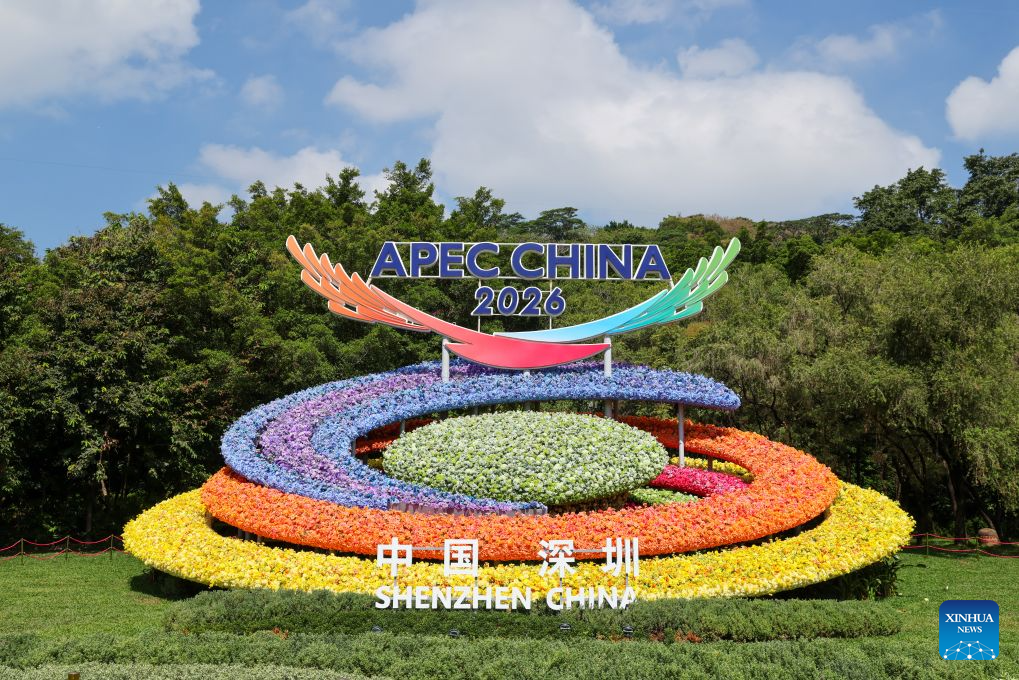
This photo shows a flower decoration themed on the 2026 APEC "China Year," in Shenzhen, south China's Guangdong Province, Oct. 17, 2026. (Xinhua/Liang Xu)
APEC Primer in Four Words: The 33rd Asia-Pacific Economic Cooperation (APEC) Economic Leaders' Meeting will be held in Shenzhen, south China's Guangdong Province, on Nov. 18 and 19 under the theme "Building an Asia-Pacific Community to Prosper Together." This four-part series unpacks four key words from that theme, one each day, to explain what APEC is and what the 2026 host year is about.
The first of those words is "community," because it answers the most basic question: what kind of group is APEC? Before asking what it means to build a community across a region of vastly different economies, cultures and levels of development, it helps to understand how APEC itself works.
A forum, not a treaty
APEC was established in 1989 by 12 economies and has since grown to 21. It runs on non-binding commitments, open dialogue and equal respect for the views of all participants. Unlike the World Trade Organization, it places no treaty obligations on its members.
Decisions are reached by consensus, and every economy has an equal say.
This approach lets economies with different systems, development levels and priorities work together without being bound to commitments they haven't chosen to make.
Why "economies"
APEC calls its participants "member economies," not "countries." The forum explains that its work centers on trade and economic issues, with members engaging one another as economic entities.
The 21 member economies range from Australia, Canada and Chile to Japan, Mexico and Vietnam, and include China and the Hong Kong Special Administrative Region. China joined in 1991.
A region of scale
Together, APEC's member economies are home to about 36 percent of the world's population. They accounted for more than 61 percent of global real GDP in 2025 and about 46 percent of global trade in goods and commercial services in 2024.
The member economies are at very different stages of development, from some of the world's largest economies to much smaller ones. That diversity helps explain why the forum's work has centered on practical goals: reducing barriers to trade and investment, and encouraging economic and technical cooperation.
How it works
Policy direction comes from the leaders of the 21 economies, backed by recommendations from ministers and senior officials. The APEC Secretariat, based in Singapore, supports the work.
The business community also has a voice. The APEC Business Advisory Council (ABAC) brings together up to three business representatives from each economy to advise officials and leaders, while the annual APEC CEO Summit provides another platform for business engagement.
The host role rotates among members each year, and each host proposes a theme and priorities to guide the year's work.
China as host
China will host the leaders' meeting for the third time in 2026, following Shanghai in 2001 and Beijing in 2014. This year's theme is "Building an Asia-Pacific Community to Prosper Together," with openness, innovation and cooperation as the three priorities.
If APEC is already a community of 21 economies, what does it mean to build one that prospers together? That is the question for the next piece in this series: Prosper.

 Follow Us
 Scan the QR Code
