Why is Europe's tech spotlight brightening with Chinese innovations?

Chinese humanoid robots perform at Web Summit 2026 in Lisbon, Portugal. (Photo/websummit.com)
At Web Summit 2026 recently held in Lisbon, Portugal, performances by humanoid robots from China stole the spotlight. Clips quickly gained traction on social media, giving overseas netizens a closer look at the appeal of Chinese technology.
At the opening ceremony, Web Summit CEO and founder Paddy Cosgrave said that future technology superstars would increasingly come from China.
At a premier global tech gathering hosted in Europe, why did Chinese tech elements keep standing out, and why was China's presence growing more prominent?
China's strong innovation capabilities are the most direct explanation.
Chinese companies including Tencent, Xiaomi, Unitree Robotics, and Pony.ai, participated in this year's summit, showcasing breakthroughs across frontier fields such as artificial intelligence (AI), embodied AI, and autonomous driving.
At the event, which brought together roughly 70,000 technology professionals, entrepreneurs and investors from around the world, Chinese innovations captured the attention of global industry players, thanks to solid technological foundations and competitive products.
The growing attention to Chinese innovation also reflects a subtle shift in the global innovation landscape.
This year's opening ceremony featured a dedicated frontier technology showcase. Chinese companies were invited to present solutions such as humanoid robots and flying cars, painting a picture of everyday life in the future for European audiences.
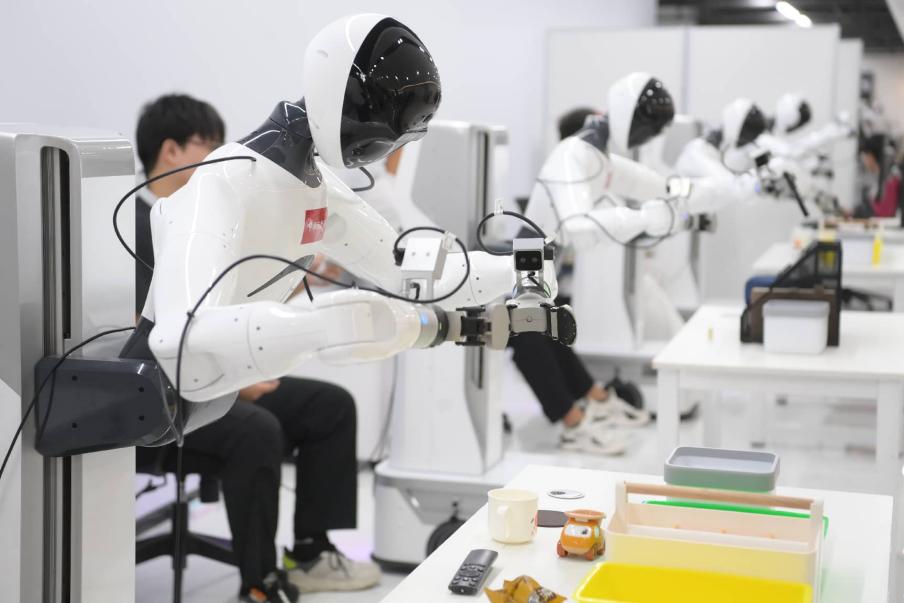
Staff members collect data in a range of scenarios at an embodied AI robot data collection and training center in Suqian, east China's Jiangsu province. (Photo/Wang Shuaifu)
For years, Silicon Valley and Europe's established research hubs were synonymous with global innovation centers. Today, when Europe looks for a tangible glimpse of tomorrow, its gaze is turning proactively toward China. That marks a shift in how the international community views China's role in innovation.
Looking deeper, the rising prominence of Chinese innovations in Europe reflects not only shared needs, but also the inevitable logic of industrial development.
Europe is home to many top universities and long-standing prowess in basic research and high-end manufacturing, yet faces bottlenecks in commercializing innovation. These include an underdeveloped digital platform ecosystem, limited cloud computing capacity, and slower AI commercialization.
Bridging the "last mile" from lab breakthroughs to market application remains a persistent challenge for European industry.
China's innovation drive has charted a differentiated path.
By leveraging a massive engineering workforce, a complete industrial chain, and vast application scenarios, new technologies can rapidly complete a closed-loop iteration from laboratory to production line to real-world applications.
Robots do more than perform on stage. They help in warehouses and retail stores. AI goes beyond conversations. It cuts costs and raises efficiency in industrial settings. What truly resonates in Europe is the substantial application potential and win-win business opportunities behind these innovations.
Still, discordant voices persist. Even as growing numbers of business leaders and researchers recognize China as an indispensable force on the global innovation landscape, some European politicians remain conflicted about Chinese technology.
They repeatedly hype the "de-risking" narrative and erect barriers in an attempt to restrict China-Europe cooperation on the sci-tech front. Yet such moves have neither changed the stance of the business and tech communities nor halted the endogenous drive for bilateral cooperation.
Sci-tech cooperation between China and Europe is inherently built on complementary strengths.
Europe's basic research and talent pool complement China's engineering capabilities and application testing. They are closely aligned in such fields as AI, green technology, and smart manufacturing.
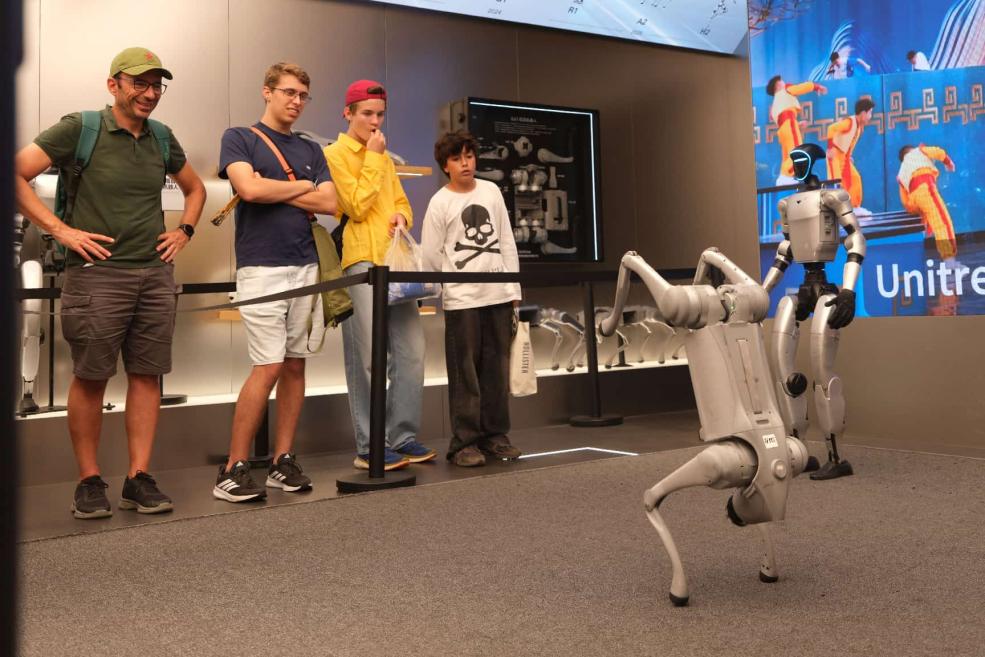
Foreign visitors watch a performance by a humanoid robot and a quadruped robot dog at a direct-operated store of Unitree Robotics on Wangfujing pedestrian street in Beijing. (Photo/Guo Junfeng)
European enterprises can draw on Chinese solutions to accelerate digital transformation, while Chinese innovation entities can leverage European resources to enhance their technologies. This model of mutual empowerment has a solid foundation and enjoys broad room to grow.
Sci-tech innovation is not a zero-sum game, and pursuing technological self-reliance is by no means synonymous with self-isolation.
Choosing diverse technology supply and broad collaborative networks gives industrial development greater resilience. Equating competition with a threat or dismissing pragmatic cooperation as dependence only limits oneself and hinders future growth.
When Europe's tech community looks toward China, it sees not only today's technological achievements, but a future of cooperation.

 Follow Us
 Scan the QR Code
